
Castle of Barletta
Italy · Europe
About
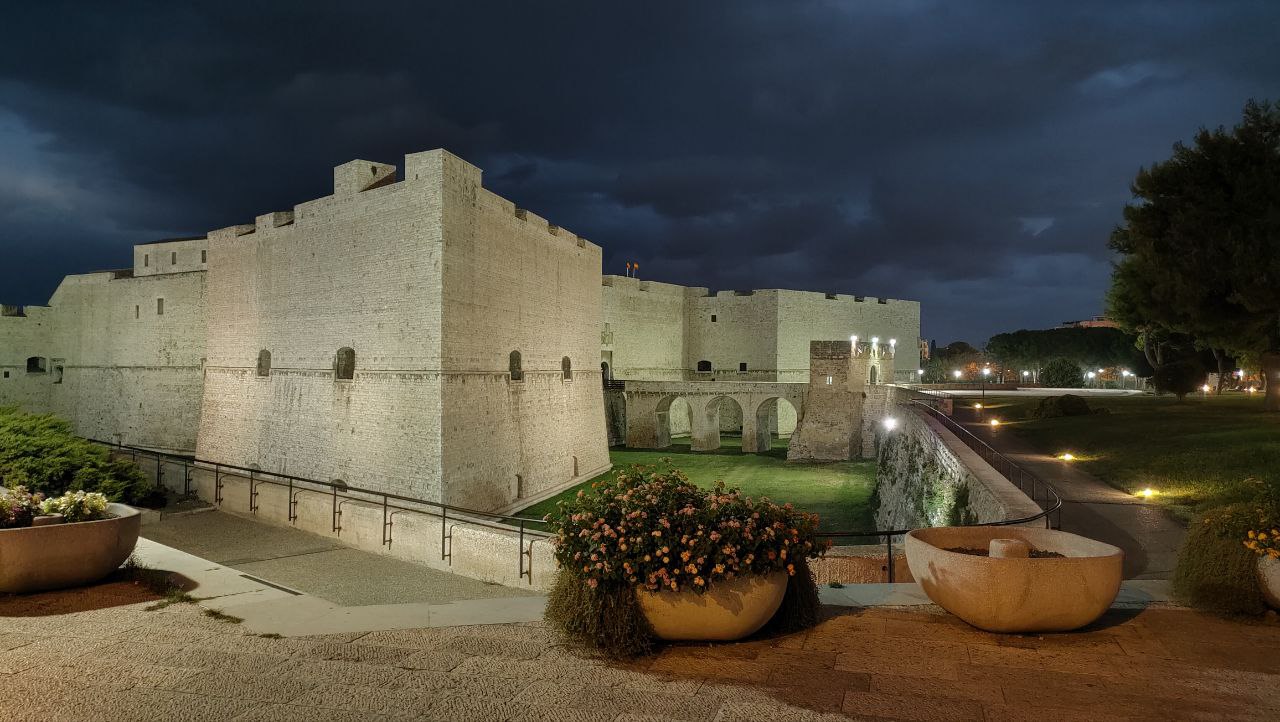
The castle of Barletta is the architectural result of various stratifications due to the succession of different ruling dynasties from the 11th century to the 18th century. Once a fortress for defensive purposes, surrounded by the sea that occupied the moat all around the castle and insulated it from potential enemy attacks, it constitutes a strategic point in city life as well as an important urban core. It is home to the Municipal Library, the Civic Museum and a conference and exhibition hall. Among the works preserved, in addition to an alleged limestone bust of Frederick II of Swabia, dating back to the 13th century, the Sarcophagus of the Apostles, the first stone high relief to bear witness to Christianity in Barletta, dating from the period between the 3rd and 4th centuries, is located here.
Hypotheses on the origin of the first nucleus of the present castle attest to its origins between 1046 and 1050 by the Normans and are based on the custom, typical of this people, of fortifying the lands close to those to be conquered by providing them with towers, in view of the subsequent occupation of the neighboring territory. For this reason Count Peter the Norman in view of a later attack on the city of Trani, held strenuously until 1054, under Byzantine rule, took possession of the undefended lands of Barletta, erecting a fortress for defensive purposes in the southeastern area of the present building. In those same years he had the first town wall built, within which the settlement was divided into the two nuclei of Santa Maria, near the castle and the ancient mother church, and San Giacomo, to the west around the church of the same name. The handover between the Norman count and his son Peter II, which took place in 1067, and the ensuing wars of succession to power involving the Hauteville family of Sicily, made Apulia an open field of war, and brought the territory of Barletta under the power of William I of Sicily, who succeeded his father in 1154, his elder brothers having died. Following the destruction of Bari, William, between 1156 and 1162, enlarged the castle's edifice, building two more towers, connected by a simple wall, to which a fourth was later added on the southwestern side, thus constituting a pseudo-trapezoidal layout fortress. In 1172 William II, son of William I, on his return from Taranto and on his way on pilgrimage to the sanctuary of Monte Sant'Angelo, stayed in the castle of Barletta, making substantial donations in favor of the Barletta clergy. Of the Norman period, which ended with the death of Tancred, cousin of William II, in 1194, only the southeast tower of the castle remained, severed in height and incorporated during the 16th-century interventions in the southern curtain of the Spanish structure. The profound restoration of the castle that took place in the 1980s, given the direct inaccessibility of the tower, allowed its internal visibility through the recovery of a hole on the ground floor protected by a metal grating.
In 1194 Frederick of Swabia, son of the King of Sicily and Holy Roman Emperor Henry VI and Constance of Hauteville, was born. After Henry's death in 1197, and Constance's in 1198, Frederick was brought under the guardianship of Pope Innocent III. This event led to extensive involvement of the church in royal affairs and makes it possible to trace the first historical record in which explicit reference is made to the castle of Barletta, in some letters of Innocent III in 1202. In 1202 the dispute for dominion over the Kingdom of Sicily flared up, pitting the Germans led by Markward von Annweiler and Dipold of Acerra against the French of Walter III of Brienne. Dipold and Markward demanded guardianship over the infant Frederick II, entrusted instead by his mother Constance to Pope Innocent III; the pontiff then appointed Walter III Prince of Taranto, Duke of Apulia and Count of Lecce and chose him as his own champion to restore control over the Kingdom of Sicily. Letters from the pontiff, sent to Walter between July 21 and September 24, 1202, testify for the first time to the neuralgic role assumed by the castle in those years along the Adriatic coast. On October 6 of the same year, near Cannae, Walter had to repel first an assault by Dipold's troops and later, after occupying Barletta and its castle, the siege of William of Palearia's troops. During the following year, after the groundless news of Innocent III's death had spread, the people of Barletta tried to take advantage of the event by besieging and driving out the pro-papal castellan who had occupied the fortress on behalf of Jacopo of the Counts of Segni in the hope of regaining the structure, though causing damage to the wall structure. Frederick's growth continued in parallel with that of the Barletta castle, in which the emperor resided on several occasions beginning in 1228. After being crowned in 1215 king of the Romans and Germany in Mainz and in 1220 consecrated emperor by Pope Honorius III, Frederick II banished the Sixth Crusade from Barletta in 1228 and in the following year, on his return from the Holy Land, stayed in the city for two months. Before 1224, the year in which the construction of the Frederician wing of the castle was promoted, the only historical document in which Barletta appears again dates from 1205 and in it the sovereign authorized the church of St. James to build a mill, a tavern and an oven. In that year, the castle complex was irregular and asymmetrical, far from the usual construction of Frederick's forts. For this reason, between 1224 and 1228, the sovereign intervened by demolishing the eastern area that had belonged to the Normans and building there the Frederician domus, accentuating the decorative and architectural aspects of the castle and transforming what had previously been a fortress for defensive purposes into a palace for his court. In 1228 Frederick visited Barletta and from there, after assembling the parliament of barons in the castle, announced his departure for the Sixth Crusade during a diet held in the domus itself. On Frederick's death in 1250 he was succeeded by his son Conrad. On May 21, 1254, with the departure of Conrad, who died in Lavello of malaria, his son Conradin, only two years old, became heir to the kingdom, whose guardianship was assumed by Manfred of Sicily, natural son of Frederick II and half-brother of Conrad. Fourteen years later, following the battle of Tagliacozzo between the Angevin troops of Charles I and the Ghibelline supporters of Conradin of Swabia, the latter was first taken prisoner and then beheaded. Thus ended the Swabian dynasty in favor of the Angevin dynasty, with the figure of Charles I of Anjou simultaneously taking over possession of Barletta and its castle.
Adapted from Wikipedia (CC BY-SA). Photography via Wikimedia Commons.