
Brahetrolleborg
Denmark · Other
About
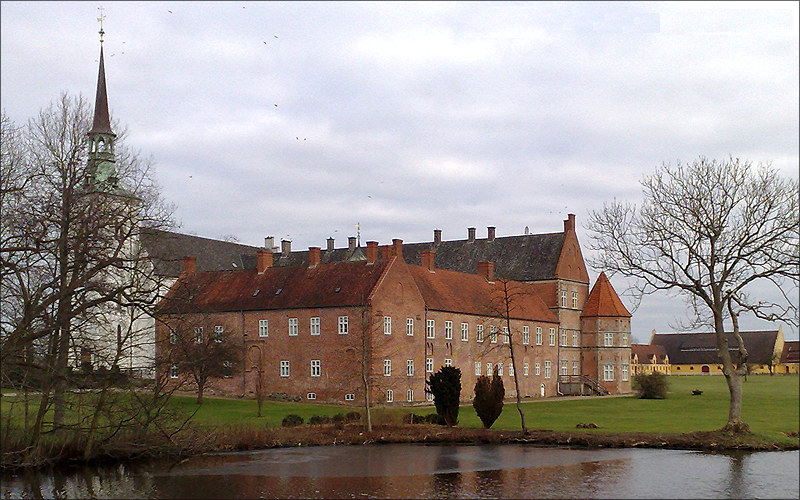
Brahetrolleborg (lit. 'Brahetrolle Castle') is a castle about 10 kilometres north-west of Fåborg on the Danish island of Fyn. Before the Reformation, the structure was a Cistercian monastery known as Holme Abbey (Danish: Holme Kloster; Latin: Insula Dei). After the reformation, the property was renamed Rantzausholm in 1568 before receiving its current name in 1667. The estate has been owned by the Reventlow family since 1722. It is currently owned by Catharina Reventlow-Mourier, the 9th generation of the family. Together with the neighboring Brændegård property, the estate covers a total of 2607 hectares, much of which is forest. The oldest parts of the three-winged main building date from the 14th and 15th centuries. The west wing (1498) was expanded for Heinrich Rantzau in 1568 and the east wing was heightened by Kaj Rantzau in 1620. The church, which forms the fourth wing of the complex, dates to the 13th century. The three-winged main building, the adiacent three-winged home farm (ladegård), a small half-timbered building, a former fairy (1679 and later) are all listed on the Danish register of protected buildings and places. The nearby Brahetrolleborg Eatermill and Brahetrolleborg Hospital are also heritagelisted.
The abbey was founded and settled in 1172 from the Cistercian Herrevad Abbey in Scania, now in Sweden, of which it was a daughter house. The monastery was initially constructed on directly on the lake of Nørresø, perhaps on a small island, hence the abbey's Latin name: Insula Dei (lit. 'Island of God'). The original building was destroyed in a fire in 1243 and the abbey was moved to the location of the current castle. In 1288, 1324, and again in 1414 the privileges of the abbey were confirmed and expanded. Although the abbey was of relatively distinguished in the Middle Ages, little of its history survives as its archive has been lost. After the Reformation in Denmark, the monastery, along with all other religious properties, became a property of the crown. In 1538, the property was leant to Clemens von der Wisch for 9,000 Lübeck Marks. In exchange, von der Wisch was to oversee the maintenance of the remaining monks at the abbey. In 1539, the monastery was leant to Christoffer Johansen Lindenov, who was to maintain the property, but no mention of the monks was made in his lease. It is likely that the abbey was quickly vacated by the Cistercian monks in the wake of the reformation. In 1540, Jakob Hadenberg purchased the property from the crown. After Jakob's death, his widow Sophie Lykke maintained the property until 1551 when it was reacquired by the crown. The crown reimbursed Sophie the 42,000 Lübeck Marks her late husband had paid for the property, but ordered that she return the object which they had removed from the property, including: some lead, a bell, and other ornaments. She was also required to compensate the crown for lands which had been sold off from the property and for the deterioration and demolition of some of the monastery's buildings which had occurred under her ownership. After the property had been reacquired by the crown, it was managed by Eskil Oxe and then Queen Dorothea of Saxe-Lauenburg.
The crown maintained ownership of the property until 1568 when Frederick II sold it to Heinrich Rantzau for 55,000 rigsdaler. The deed allowed Heinrich to establish an estate on the former abbey's grounds to be inherited by his male descendants. The estate was thus established as Rantzausholm. After Heinrich's death in 1598, the estate was inherited by his son Breide Rantzau. After Briede's death in 1618, the estate passed to his son Kai Rantzau who died in 1623 and left the estate to his brother Frands. After Frands drowned in 1632, the estate was transferred to Kai Rantzau's only child, Sophie, before being transferred to his widow, Anne Lykke, in 1635. Anne died in 1641 and the property was transferred to her brother Frands Lykke, and then to his son Kai Lykke in 1646. After accusing Queen Sophie Amalie of adultery, Kai Lykke was involved in a scandal in the 1660s which led to his conviction, exile, and the confiscation of all of his properties by the crown. As a result, the estate once again became a possession of the crown in 1661. After the Carl Gustav wars, the manor had become dilapidated and was in severe disrepair. In 1664, Frederick III granted the estate to his court favourite, the German merchant and politician Christoffer Gabel. In 1667, the estate again was returned to the crown.
Adapted from Wikipedia (CC BY-SA). Photography via Wikimedia Commons.