
Bilhorod-Dnistrovskyi Fortress
Ukraine · Europe
About
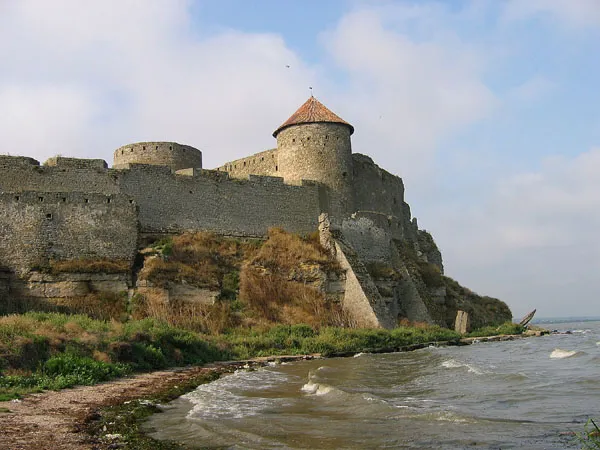
The Bilhorod-Dnistrovskyi fortress or Akkerman fortress (Білгород-Дністровська фортеця, or Акерманська фортеця; Romanian: Cetatea-Albă; also known as Kokot) is a historical and architectural monument of the 13th–14th centuries. It is located in Bilhorod-Dnistrovskyi in the Odesa Oblast of southwestern Ukraine, in the Budjak, the historical region of Bessarabia.
The fortress was built on the remains of Tyras, an ancient Greek city on the northern coast of the Black Sea which existed until the 4th century. Frequent attacks by invaders (Goths and Huns) destroyed the city. Antes, Slavs, and Bulgarians lived on the site of Tyras after the Greeks. In the 10th century, Bilhorod was part of Kievan Rus'. Later it was owned by the Kingdom of Hungary, then the Principality of Galicia–Volhynia, where it stayed until the invasion of the Mongols. It is not known when construction began on the fortress. Most historians today believe that it was a trading exclave of the Republic of Genoa on the Black Sea, first established in the 13th century. The territory was surrendered to the Golden Horde, but the Genoese managed to ally with the Mongols. Bilhorod was officially a Tatar city, but ruled by the Genoese; the fortress controlled the estuary of the Dniester. In the second half of the 14th century, the Genoese lost their influence in the Black Sea region and secure passage across the Aegean Sea, because of increasing military pressure from the Ottomans. According to most historians, Lithuania came to replace Genoa. In the 14th century, the Principality of Moldavia gained control over the Lithuanians.
After the territory came under the control of the Principality of Moldova, the Moldavians called it Cetatea Albă (literally White Citadel). In the 15th century the city was a metropolis with about 20,000 inhabitants - Moldavians, Greeks, Genoese, Armenians, Jews, Tatars. It was the start of the greatest development period in the city's history. The city was based on a fortress, which had already grown significantly. Its main elements had been constructed by 1440. The fortress had 34 towers, some as much as 20 meters tall. Outside, the fortress was surrounded by a deep moat. The fortress was built of white limestone, for which a mortar made of eggs, crushed marble, carbon, and silicon was used.
In 1440 one portion which was neither a wall nor a castle tower was completed. This segment is located outside the castle walls very close to the estuary and has remains preserved today. Inside the wall, 10 stone cores were inlaid in the wall as a kind of talisman. This part of the wall had no practical defensive value. For a long time historians and architects could not identify the purpose of it. The cores inside the wall were shaped like a tetractys: a figure with ten points that form nine equilateral triangles. Some historians have speculated about its potential symbolic meaning, but the precise purpose remains unclear. When in one of the towers, a plate was found, inscribed with: "Master Fedorko finished construction in 1440", some jumped to such a conclusion based solely on the grounds of the usage of the word "master". Another explanation of Bilhorod's tetractys is much more pragmatic: some claim it is just a variant of a sundial calendar. In the second half of the 15th century, the Moldavian principality was marred by a civil war between different factions, and king Bogdan II was murdered in an ambush by his brother Peter III Aaron in 1451. In 1457, the throne of Moldavia was captured by Stephen III of Moldavia (son of Bogdan II) with the help of his cousin Vlad the Impaler, prince of Wallachia. Since Cetatea Albă was the main defensive center in the southeast of the state, located right on the trade route between Europe and Asia, it was given renewed attention under a new ruler. The fortress was constructed and reinforced with new stronger walls and a large gate, which then served as the main entrance to the fortress. In order to guard it, a permanent garrison was placed.
Adapted from Wikipedia (CC BY-SA). Photography via Wikimedia Commons.