
Barony and Castle of Giffen
United Kingdom · Europe
About
The Barony of Giffen and its associated 15th-century castle were in the parish of Beith in the former District of Cunninghame, now North Ayrshire. The site may be spelled Giffen or Giffin and lay within the Lordship of Giffin, which included the Baronies of Giffen, Trearne, Hessilhead, Broadstone, Roughwood and Ramshead; valued at £3,788 9s 10d. The Barony of Giffen comprised a number of properties, including Greenhills, Thirdpart, Drumbuie, Nettlehirst and Balgray, covering about half of the parish of Beith. Giffen was a hundred merk land, separated from the Barony of Beith, a forty-pound land, by the Powgree Burn which rises on Cuff hill. The Lugton Water or the Bungle Burn running through Burnhouse may have been the Giffen barony boundary with that of the adjacent barony and lands of Aiket castle. Giffen has a recorded history that covers many familiar aspects of a feudal barony, including the possession of a moot hill or justice hill, here represented by 'Greenhills', as well as a thirled mill and a 'gathering place' known as the 'Borestone'. Other features such as the old chapel and the holy well add to the expected features, most of which no longer survive.
Giffen is a Brittonic place name. It is named either from *cemno, meaning "ridge" (cf. Welsh cefn), much like The Chevin in West Yorkshire, England, or *cöfin, a word adopted from Latin meaning "a common/shared boundary" (Welsh cyffin).
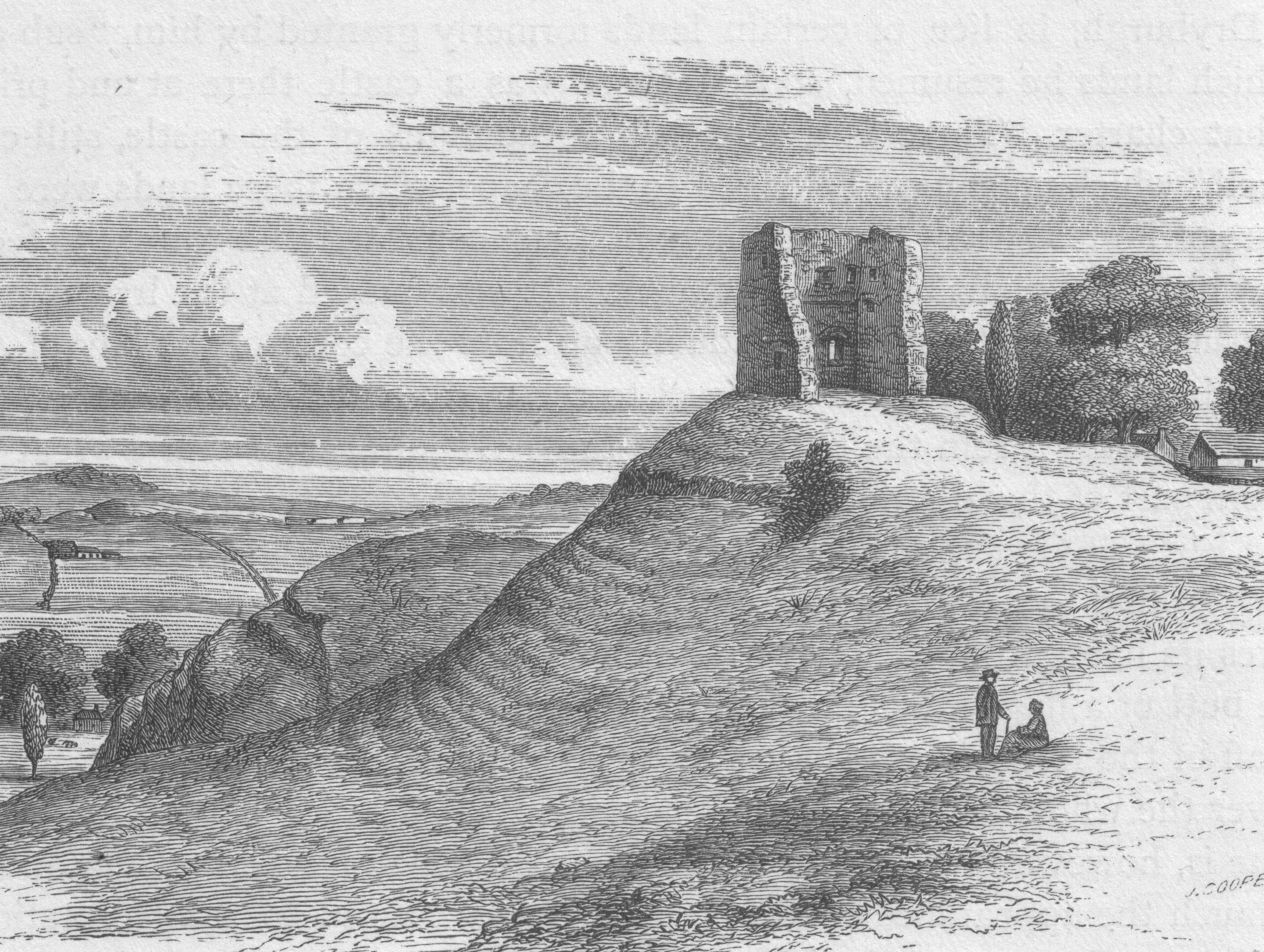
The 40-foot-high (12 m) tower castle of Giffen lay near to the existing Mains of Giffen site on the 180-foot-high (55 m) summit of a whinstone trap ridge at (NS 37727 50718). MacGibbon and Ross suggest that Giffen Castle was built in the 15th century, although the 13th-century (1233) land grant to Walter de Mulcaster, and the prior existence of a chapel, suggest that a defensive structure of some sort was present at that date. At the time of Pont's survey (J Dobie 1876), it was a tower 30 ft (9.1 m) square, 40 ft (12 m) high, with walls 6 ft (1.8 m) thick. It fell into disrepair soon after 1726 and finally collapsed in 1838. It has also been recorded as 'Griffen' on some old maps of the district.
The castle was acquired by Sir John Anstruther in the early 18th century and he is responsible for allowing it to become a ruin, together with the associated Giffen farm. The sundial originally in the Giffen castle garden was sold and was moved eventually to Crummock house, Beith, now demolished. In 1959 the sundial was reported to be located at Craigbet, Renfrewshire. This sundial had its horizontal plane divided by volutes, between which a lion's head alternates with a rose; it was made in 1719 and repaired in 1810. George King of Giffen Mill was permitted by Robert Craig of Giffen Farm in 1726 to remove the stones he needed to build a dwelling house at the mill. The castle roof was taken off and the interior exposed to the elements. Local farmhouses were built using stone from the front wall of the castle, which was consequently entirely removed. Above the entrance, with its strong iron door, there had been a carving of a man shooting with a crossbow at what has been called a wild boar. It is not unlikely that this commemorates a feat of bold hunting by a member of the family of Giffen. A similar carving at Linton parish church commemorates just such a feat, for which William the Lion knighted the bowman and bestowed upon him the lands and barony of Linton. For some years after the roof was removed youths would climb the circular stairs and light a fire on the eve of the feast of St Ennan, the saint of the parish. In 1837 the castle's south wall fell and finally on 12 April 1838, during the silence of the night, the north and east walls of the old castle fell leaving little more than a disorderly heap of stones. The adjacent Mains of Giffen farm had been feued by Anstruther to Robert Craig in 1726. John King of 'Giffin Miln' built his house using stone from the castle and this is probably how the old carvings came to be incorporated into the walls of this building. The doorjambs are also said to have come from the old castle. Thomas Craig, grandson of Robert, passed on the feu to Thomas White in 1816, during whose possession the castle met its final fall, inspiring the following indignant poem by James Wilson, the local poet:
Adapted from Wikipedia (CC BY-SA). Photography via Wikimedia Commons.