
Baltersan Castle
United Kingdom · Europe
About
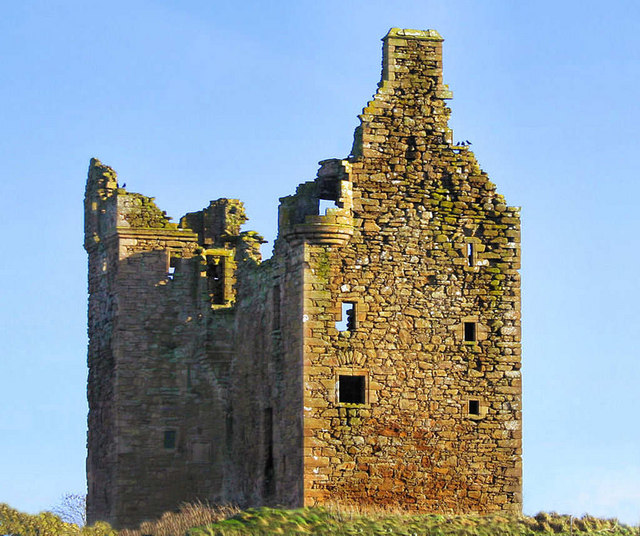
Baltersan Castle is a ruined L-plan tower house near Maybole in South Ayrshire, Scotland. It stands close to Crossraguel Abbey, on the site of an earlier house associated with the Kennedy family of Carrick. The present tower was begun in 1584 for John Kennedy of Pennyglen and his wife Margaret Cathcart. It was abandoned about the middle of the 18th century and has since stood as a ruin. Baltersan was first listed as a Category B building in 1971 and was upgraded to Category A in 1995. It is recorded on the Buildings at Risk Register for Scotland.
Baltersan Castle lies in the former parish of Kirkoswald, about a mile south-west of Maybole and a short distance north-east of the ruins of Crossraguel Abbey, within the agricultural landscape of Carrick. The lands of Baltersan were historically connected with the abbey and passed into Kennedy hands in the later 16th century. The tower is prominently marked, with its enclosing parkland, on the map of Carrick in Joan Blaeu's Atlas Novus (1654), which derived from the survey of the cartographer Timothy Pont.
A stately fyne house, with gardens, orchards, parks and woods about it.
Before the present tower, the site was occupied by an earlier house or manor-place. The best-known early figure associated with it is Egidia (Giles) Blair, Lady Row, who died at Baltersan in 1530. Her tomb survives in nearby Crossraguel Abbey, marked by a carved slab of about 1530, and her surviving will records gifts to the abbey, local clergy, relatives and neighbours. After her death the earlier house appears to have been taken down.
The lands of Baltersan passed to the Kennedys in 1574, after Gilbert Kennedy, 4th Earl of Cassillis obtained them from Allan Stewart, commendator of Crossraguel Abbey. Secondary accounts credit David Kennedy of Pennyglen with the building, while the now-weathered inscription over the entrance named John Kennedy of Pennyglen and his wife Margaret Cathcart and recorded that the house was begun on 1 March 1584. The Kennedys were among the dominant families of Carrick, and Baltersan formed part of a wider Kennedy landscape that included Crossraguel, Culzean and Cassillis. John Kennedy, "apparent of Baltersan", was recorded as a royal servant in 1601.
During the 17th century Baltersan passed through related Kennedy branches, including the Kennedys of Culzean, Craigoch and Ardmillan; Major Thomas Kennedy of Baltersan is on record in the 1680s. The line ended when John Kennedy of Baltersan died without children in London in 1721, after which the estate became the subject of litigation. The property then passed to Captain Hugh Arbuthnot, a Kennedy cousin, usually regarded as the last known inhabitant. By the middle of the 18th century the castle had been abandoned and fell into ruin.
After the inhabited period, Baltersan lay within the wider estate background of the Kennedy family, later Earls of Cassillis and Marquesses of Ailsa. By the later 19th century the property had passed into private hands: it was acquired by Peter Sturrock (1820–1904), a Kilmarnock civil engineer, colliery owner and Provost of Kilmarnock who sat briefly as Conservative Member of Parliament for Kilmarnock Burghs from 1885 to 1886. Styling himself "of Baltersan", Sturrock intended to restore the castle, but the work was never carried out; he died in 1904. The Baltersan lands remained associated with the Sturrock family into the mid-20th century before returning to the Cassillis and Culzean estate of the Kennedys by a deed recorded in 1948. The castle itself was thereafter held by trustees of Archibald David Kennedy, 7th Marquess of Ailsa until 1989.
Adapted from Wikipedia (CC BY-SA). Photography via Wikimedia Commons.