
Al Bithnah Fort
See all in United Arab Emirates →
United Arab Emirates · Asia
About
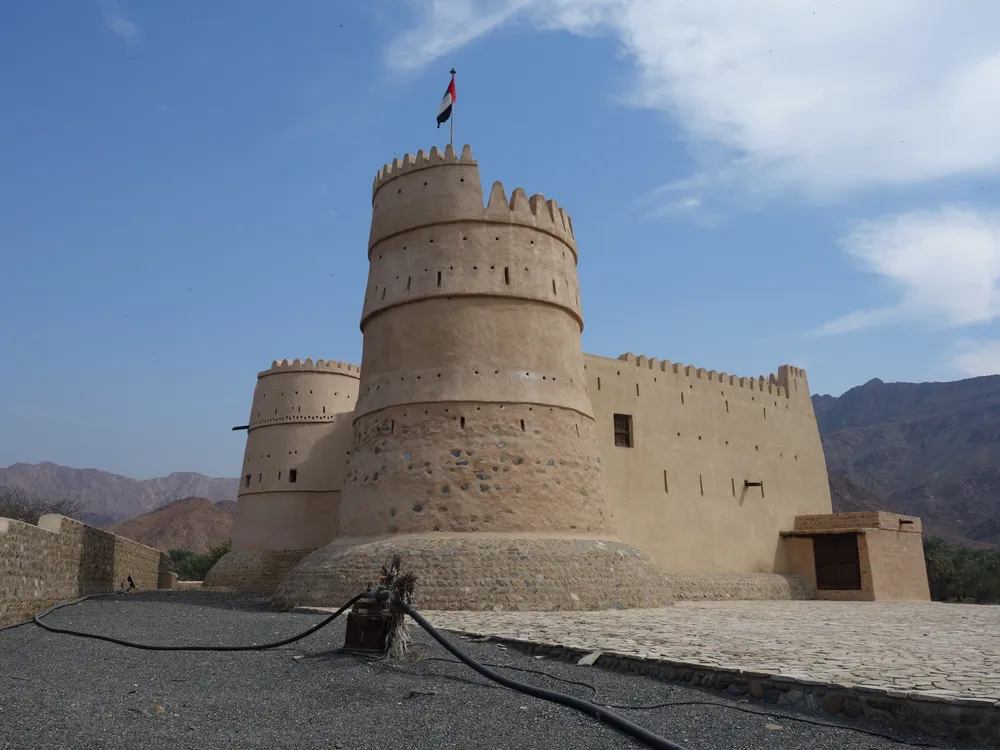
Bithnah Fort is a traditional double story rock, coral and mudbrick fortification located in the Wadi Ham, near the village of Bithnah in Fujairah, United Arab Emirates. The fort has played a significant role in the history of the Emirates, particularly in the emergence of Fujairah as an independent emirate in the early 20th century. With a controlling position overlooking the Wadi Ham, the fort replaced an Iron Age fortification. Prior to the construction of the metalled road between Fujairah City and Masafi in the 1970s, traffic to the interior from the coast passed through the bed of the wadi, controlled by Bithnah Fort, which has through the ages been a keenly contested strategic holding and was to form a key mainstay in the fortunes of the Sharqiyin through the 18th and early 19th centuries.
Bithnah Fort is a rectangular construction with two round corner towers. A rectangular guard's room gives the outward appearance of forming a third tower. It is principally constructed of stone walls, topped with mudbricks bound and covered in mud-based mortar. Wood joists and ceiling beams are made principally from date palm planks, although sparing use of hardwood was also made. The entrance, to the eastern wall of the fort, leads to a 3.3 metre corridor covered with hardwood slabs. This narrow entrance leads, in turn, to a subterranean room and then, via a ladder, to the courtyard. Restoration work in 2008 revealed traces of this room being used as a madbasa, a date storage room with channelled floors to collect the date juice, or dhibs. Although the fort is known to have been in existence by 1808 (it was possessed at that time by Saudi Wahhabi forces), it is thought the fort could have been constructed at any time following 1745. Traditional repairs to the fort have been made using mud-based renders. Bithnah Fort was to preside over a century of conflict between the tribes of the west coast and interior against Muscat, with the outside forces of Wahhabi Saudi Arabia and Persia often becoming involved as alliances shifted and military forces found success or failure. Its eventual fall to the insurgent Sharqiyin of Fujairah was to cement the independence of Fujairah from rule both by Muscat and the Qawasim.
Bithnah occupies a strategic location in the Wadi Ham, which links the East Coast port of Fujairah to the inland town of Masafi and stands as one of the three great trade routes (the others are the Wadi Jizzi and the Wadi Hatta) through to the interior and western ports of the Southern Arabian Peninsula. As such, it has long been a flashpoint in the region's conflicts, not least of which was that between the Qawasim of Sharjah and Ras Al Khaimah and the Na'im of Buraimi ranged against the Saidi Sultan of Muscat. In 1745, the Qawasim together with the Na’im attempted to fight their way through the Wadi Ham to take the east coast and its great prize, the port of Sohar. They met the Saidi forces at Bithnah and the Battle of Bithnah ensued, a conflict that was to mark a new era in the history of the area: the drawn-out battle between the Saidi Omani leader Ahmed bin Said Al Busaidi against the Qawasim of Ras Al Khaimah and Sharjah, and other tribes of the West coast and interior. The Battle of Bithnah was won by the Qawasim when the troops of Ahmed bin Said deserted him. The conflict rumbled on until, in 1762, a newly resurgent Ahmed bin Said (he had by now unified the querulous Omani tribes) blockaded Julfar, while the Qawasim moved against Rustaq. These raids across the mountains continued until 1792, when a great raid took place by the Na’im of Buraimi against Sohar, resulting in the fall of the city to the raiders. Reinforced by the Bani Yas of Dubai (under their Ruler, Hazza) and the Bani Qitab, the Na’im were however defeated, retreating down the Wadi Jizzi to Buraimi. Ahmed bin Said's forces, triumphant, also sacked the important port town of Dibba by sea, killing many members of the Naqbiyin and Sharqiyin tribes.
Adapted from Wikipedia (CC BY-SA). Photography via Wikimedia Commons.