
Ouvrage L'Agaisen
France · Europe
關於
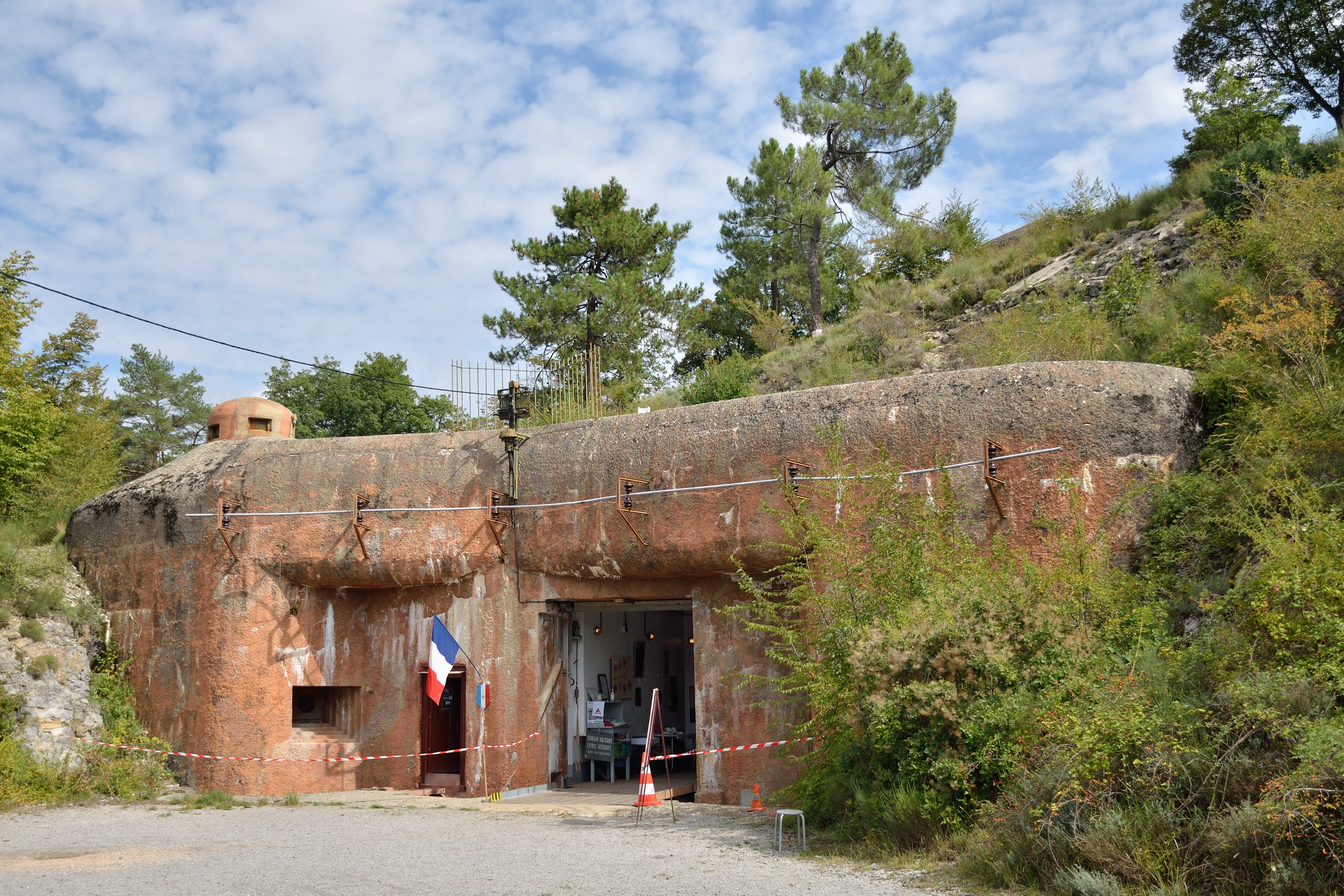
Ouvrage L'Agaisen is a work (gros ouvrage) of the Maginot Line's Alpine extension, the Alpine Line, also known as the Little Maginot Line. The ouvrage consists of one entry block, two artillery blocks and one observation block above Sospel. Additional blocks were planned but not built. The ouvrage was built at the top of Mount Agaisen, overlooking, at an altitude of 750 metres (2,460 ft), the Bévéra valley and Sospel from the north.
It saw significant action during the Italian invasion of France in June 1940 at the start of World War II. Its Block 3's 75 mm gun turret alone fired an 1821 rounds in 1940, playing a crucial role in repelling the Italian troops advance in the Nice region. After the occupation of the Free Zone in 1942, the site fell under Italian control, and later into German hands who turned it against the Allies following the Allied invasion of Southern France in August 1944. As the Germans retreated in October 1944, they sabotaged the installations to prevent their use by the advancing Allies. Nevertheless, American forces swiftly restored the position and used it against the retreating Germans in one of the final military operations associated with the Maginot Line.
The ouvrage was built between 1930 and 1935, and was equipped from 1935 to 1937. It has an unusual 75 mm gun turret in Block 3. L'Agaisen possesses an instruction casemate that was used to allow soldiers to practice attack and defense skills. The garrison numbered about 300 officers and men. The work was primarily garrisoned by troops from the 95th Bataillon Alpin de Forteresse (BAF) and the 158th Régiment d'Artillerie de Position (RAP).
Maintained in operational condition during the Cold War to be used for the training of engineering personnel of the French army, it has been maintained by a volunteer association since 1992 and is now open for visits. It has been listed as French national heritage site since 2016.
內容改寫自 Wikipedia (CC BY-SA)。照片來自 Wikimedia Commons.