
Grauerort Fortress
Germany · Europe
關於
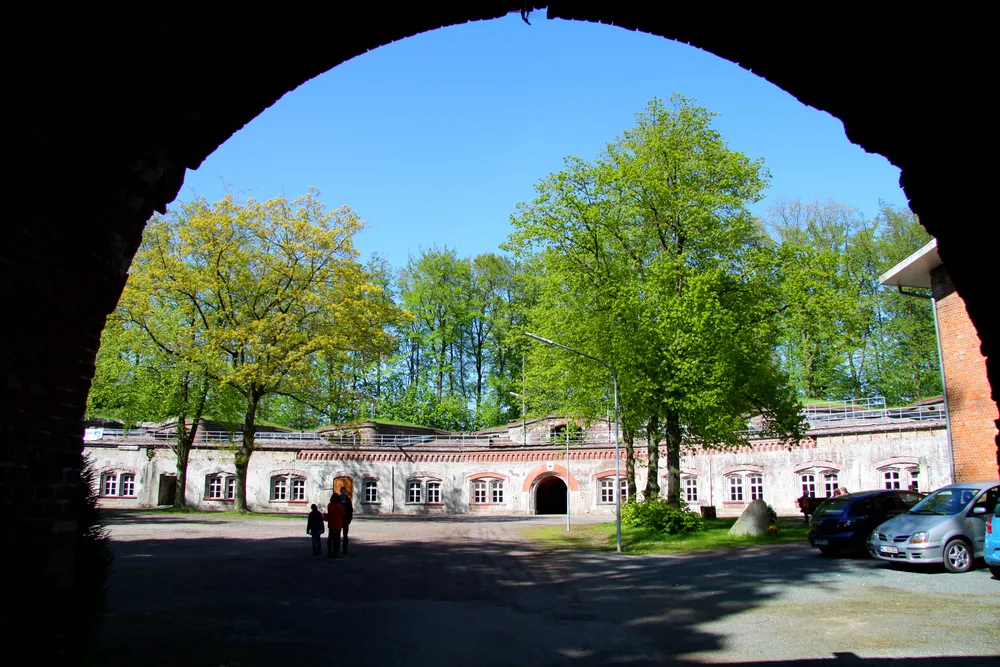
Grauerort fortress is a German artillery fort on Elbe river about 9 km (5.6 mi) north of Stade which was built between 1869 and 1879 to defend the Port of Hamburg. Its shape is hexagonal, taking advantage of the topography of the area and the location of the previously existing levee. The main armament of the fort were probably ten 21 cm breech-loading guns (as opposed to the initially planned four 28 cm and six 21 cm guns), but they are no longer in place. There were also 4 12 cm and six 9 cm guns. Construction materials were cement and brick; concrete was only used from 1885 onward.
While the fortress was in service during the Franco-Prussian War in 1870–71, it was never involved in any battles. After World War I, Grauerort was converted to a naval mine arsenal. Unused since 1985, it has been mostly restored to its original 19th-century state since 1997, and now serves as a museum and cultural venue.
Grauerort has a 250 m Elbe pier which was used to load ships with naval mines. After WW II, a popular restaurant, Klein Helgoland ("Little Heligoland"), was located on the pier. Its popularity was because until 1955, Heligoland was off-limits to passenger ships, therefore people from Hamburg visited Klein Helgoland instead on their day trips.
Between 1959 and 1985, decommissioning of ammunition took place in Grauerort. 1992 and 1995 chemical analyses of the soil at Grauerort revealed significant concentrations of, among others, PCNs, TNT, RDX, and cadmium up to a depth of 3 m, raising the concern that hazardous substances could leach into the local groundwater supply.
內容改寫自 Wikipedia (CC BY-SA)。照片來自 Wikimedia Commons.