
Maijishan Grottoes
People's Republic of China · Asia
關於
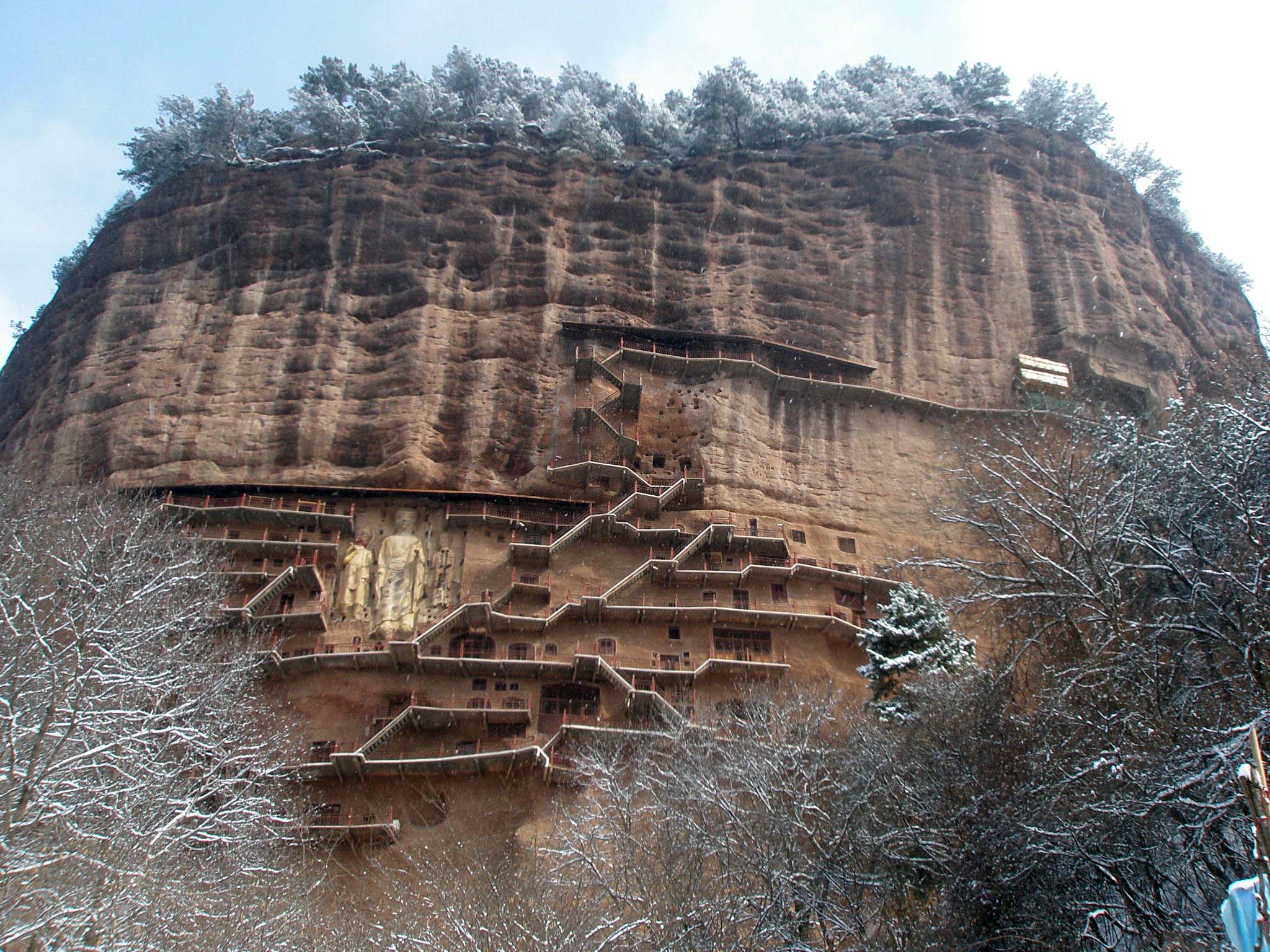
The Maijishan Grottoes (simplified Chinese: 麦积山石窟; traditional Chinese: 麥積山石窟; pinyin: Màijīshān Shíkū), formerly romanized as Maichishan, are a series of 194 rock-cut caves cut into the Maijishan hill in Tianshui, Gansu Province, northwest China. They contain over 7,200 Buddhist sculptures and over 1,000 square meters of murals.
The name Maijishan consists of three Chinese words (麦积山): mai (麦) is the generic term for most grains, ji (积) means "stack" or "mound", and shan (山) means "mountain". Maijishan is often translated as "wheatstack mountain" or "corn rick mountain".
The mountain is formed of purplish red sandstone. Construction of the grottoes began in the Later Qin era (384–417 CE). A team of Chinese archeologists from Beijing conducted the first modern exploration in 1952–53. They devised the numbering system still in use today. Caves #1–50 are on the western cliff face, while caves #51–191 on the eastern cliff face. The grottoes were later photographed by Michael Sullivan and Dominique Darbois, who subsequently published the primary English-language work on the caves noted in the footnotes below.
The Maijishan Grottoes are just one of the string of Buddhist grottoes that can be found in this area of northwest China, lying more or less on the main routes connecting China and Central Asia. These sites, along with other archeological sites along the eastern Silk Road, were inscribed on the UNESCO World Heritage List in 2014 as part of the "Silk Roads: the Routes Network of Chang'an-Tianshan Corridor" site.
內容改寫自 Wikipedia (CC BY-SA)。照片來自 Wikimedia Commons.