
Zambia
Zambia · Africa
關於Zambia
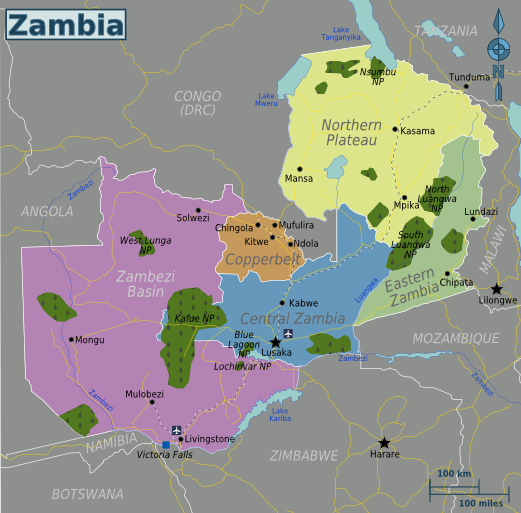
Zambia offers travelers some of the world's best safari opportunities, a glimpse into "real Africa", and Victoria Falls, one of the World's Seven Natural Wonders and a UNESCO World Heritage Site.
Zambia旅遊指南
城市概覽
History The territory of Northern Rhodesia was administered by the South Africa Company from 1891 until it was taken over by the UK in 1923. During the 1920s and 1930s, advances in mining spurred development and immigration. The name was changed to Zambia upon independence in 1964. In the 1970s, 1980s and 1990s, declining copper prices, one party democracy and a prolonged drought hurt the economy. Kenneth Kaunda, who led the fight for independence, instituted one party rule, which came to an end in 1991. Since then, Zambia has been a multi-party democracy.
Economy
Much of Zambia remains desperately poor, with GDP per capita on the order of US$600/year, and the bulk of Zambia's population lives on subsistence agriculture. The economy continues to revolve around copper, but after decades of mismanagement the industry is now doing better thanks to higher commodity prices and investments made after privatisation. The country's tourism sector has benefitted from the misfortunes of its neighbour Zimbabwe as tourists have flocked to the northern side of the Victoria Falls and Zambia's safaris.
People As can be seen even from the bizarre squashed-peanut shape of the country, Zambia is one of the stranger legacies of colonialism, agglomerating a large number of different ethnic groups (73, according to the official count) and languages (20, plus dialects). Fortunately, with a long history of coexistence, significant migration around the country and similar Bantu-family languages, they all seem to get along pretty well and Zambia has been spared the violent interethnic strife that has decimated countries like Rwanda. The Bemba are the largest ethnic group in Zambia, but they still form only about 20% of the population. The Bemba came from the Congo in the 16th century, and while their homelands are in the north and centre of the country, many have immigrated to Lusaka and the Copperbelt. The Chewa, Ngoni and Nsenga tribes, all found in the east of the country, sh
如何抵達
Visas
Most Western visitors no longer need a visa to enter Zambia. Visa-free entry is also possible for some nationalities, including Malaysia, Singapore, Zimbabwe and South Africa. See the immigration department's web-site for the full list of visa-exempt nationalities. Current visa prices for anyone that needs a visa are US$50 for a single-entry and US$80 for a multiple-entry visa for all nationalities and is valid for 3 months;
A day entry visa is available to any nationalities that need a visa at US$20, valid 24 hours Transit visas carry the same cost as a single entry visa, valid 7 days There is also the 30-day US$50 Univisa which is good for both Zambia and Zimbabwe. The Univisa can only be obtained at Livingstone airport, Victoria falls land border, Kazangula Botswana border and Lusaka airport. Do check with the nearest Zambian embassy for the latest information; the Zambian Embassy to the US has some information on their homepage, and getting the visa before arrival will reduce the uncertainty factor. If you require a visa to enter Zambia, you might be able to apply for one at your embassy or consulate in the country where you legally reside if there is no Zambian diplomatic post. For example, the British embassies in Al Khobar, Amman, Belgrade, Budapest, Guatemala City, Helsinki, Jakarta, Jeddah, Kyiv, Prague, Pristina, Rabat, Riga, Riyadh, Rome, Sofia, Tallinn, Vienna, Warsaw and Zagreb accept Zambian visa applications (this list is not exhaustive). British diplomatic posts charge £50 to process a Zambian visa application and an extra £70 if the authorities in Zambia require the visa application to be referred to them. The authorities in Zambia can also decide to charge an additional fee if they correspond with you directly. Lusaka Airport Customs and Immigration is unprepared to deal with lots of tourists. There are four lanes, segmented by: Zambian passport holders; Residents; Tourists; and Diplomats. Tellingly, the lane for tourists is sometimes uns
當地交通
Zambia is large and distances long, so budget plenty of time for getting around.
By plane Domestic flights on Proflight connect Zambia's major cities and tourist destinations. While undoubtedly the fastest and most comfortable way of getting around, they are quite expensive with an hour-long flight (say, Lusaka-Mfuwe) typically costing around US$150 one-way. Also note that planes are small and schedules sparse, but if you can rustle up enough people you can also charter planes for not much more.
By minibus
Minibuses — meaning vans outfitted with seats — are popular, but they are often irregular, dangerous, and uncomfortable. To maximise profits, a "conductor" will squeeze as many paying customers — and their luggage, or katundu (ka-TOON-doo) — into the bus as possible; whether or not the customers are comfortable is irrelevant. In terms of meeting locals, however, this method is among the best, and it can provide a traveler with a truly "authentic" experience. Payment is made during the journey — banknotes are passed down the bus to the conductor at the front, and change comes back via the same route.
By bus Larger, more sophisticated "luxury coaches" exist, too Power Tools, Juldan Motors, UBZ. These tend to be more reliable and safer; they depart on-time; they have dedicated space for guests and luggage; and tickets may be purchased in advance. Luxury coaches are much more comfortable and are virtually guaranteed to arrive, but they might seem "generic" to a seasoned traveler.
By car Vehicles drive on the left side of the road in Zambia – at least most of the time.
Car rental agencies exist in Zambia, but the costs are potentially great. Not only are rental rates high (US$100/day), but some of the main roads in Zambia are in very poor condition. Potholes often take up the entire road, and during the rainy season, large sections of the roads wash away. As you move away from city centres (possibly only a kilometre or so away) you will encounter d
必看景點
With national parks all over the country, it's never hard to find a piece of postcard-perfect Africa in Zambia. The country offers excellent safari opportunities, and parks range from popular tourist destinations to seemingly unexplored wilderness. There's an amazing array of wildlife to spot, and elephants, giraffes, huge herds of grazers, lions and hundreds of kinds of birds are only the tip of the iceberg when talking about Zambia's fauna. South Luangwa National Park is surely the most famous one, and a travellers' favourite because of its dense and greatly varied population of wild animals. North Luangwa National Park is far less crowded and known mainly for the massive herds of buffalo and the large lion prides that roam its area. Even more off the beaten track - to the extent that even dirt roads are very limited - is Lower Zambezi National Park. The fact that it was the private hunting ground for the president ensured that development remained limited and the real, untouched Afr
城市概覽改寫自 Wikipedia,旅遊指南來自Wikivoyage (CC BY-SA)。照片來自 Wikimedia Commons.