
Uptown Charlotte
United States · Americas
關於Uptown Charlotte
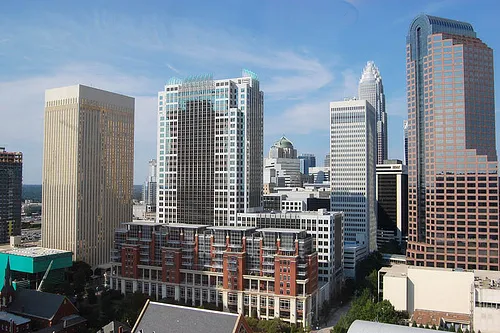
Uptown is the central business district of Charlotte. It is home to most of the city's major institutions, and is the historic core. It is also the geographic center of Charlotte, with the center point of the city at the intersection of Trade and Tryon Streets.
Uptown Charlotte旅遊指南
城市概覽
Wards The four wards were the original political divisions of the city, and part of Uptown. The axis that determines their boundaries is along Trade and Tryon St., but few people consider the canyon of skyscrapers at the center of the city to really be identifiable as part of the wards. Each ward has its own personality:
First Ward — Very heavily residential, but beginning to feed commercially off ambitious projects such as the light rail and arena. This area was almost entirely public housing for several decades, but was redeveloped with great success as a mixed-use, mixed-income neighborhood. Now it is a vibrant and well-kept neighborhood that seems quaint against the backdrop of skyscrapers nearby, and its attractiveness is verified by several major residential developments. Second Ward — Now the city's government center, this area was the victim of a short-sighted urban renewal project in the 1960s. It had been the Brooklyn neighborhood: a largely impoverished but self-sufficient African-American district that was deemed unsightly and dangerous by city planners. Today, Second Ward is by far the most lifeless quarter of Uptown after working hours, as government workers disperse quickly and head to other parts of the city to live and play. A good place to find parking at night, but a bit of a social vacuum that can be a bit isolated. Third Ward — Much of Third Ward was lost to the decline of industry in the center city, but what is left still largely reflects a very blue-collar industrial heritage. Bank of America Stadium (home of the Panthers) is the ward's most recognizable symbol, though a new park and a proposed baseball stadium have provided good reason to believe that this may be a major center of growth in coming years. Third Ward's largest current development is the gleaming Gateway Village, home to many offices and the Johnson and Wales University campus. Straddling W. Trade St. between Third and Fourth Wards, Gateway Village is one of the city's most
如何抵達
Almost all visitors arrive by car. Though Uptown is easily walkable and bike-friendly in most places, the I-277 loop makes travel into and out of the district difficult for anything other than auto traffic. The 19-mile (31-km) Lynx Blue Line light rail runs from the University of North Carolina at Charlotte in University City through NoDa, Uptown, and South End, then parallels South Boulevard to its southern terminus just north of Interstate 485 at the Pineville city limits. The largest artery in the area is I-77, which joins with I-277 to circle the city center. Most of the time these highways flow quickly; however, it is worth keeping an eye out for construction alerts. Roadwork, or even the most minor of accidents, can bring traffic to a crawl on the interstate. NC Highway 74 also forms part of the big loop; the eight-lane freeway becomes Independence Blvd. to the east and Wilkinson Blvd. to the west. The city's Greyhound bus station is on Trade St. near the edge of Uptown. It is a very direct, convenient walk from the center of the city.
Parking Parking is usually abundant in the center city, though it has become something of an issue during large events that overload the area with cars. Visitors will immediately notice the large number of surface lots at the edges of Uptown, which makes finding a parking space relatively easy. However, these lots can be somewhat expensive; their prices will reflect their proximity to Tryon St. Savvy travelers can save money by parking in the cheaper lots ($3 near 277) and using a Gold Rush trolley to take a free trip to the attractions of their choice. Parking decks are also available in most of the highrises near the center of Uptown. However, they are usually much more expensive than lots and often reserve spaces for regular visitors. If you are interested in taking panoramic photos, park on the top of the 10-story Seventh Street Station parking deck for an open-air view of the city and surrounding areas (but do it qu
當地交通
By foot Uptown Charlotte is very dense, and almost all attractions in this part of town are easily reached by walking. Drivers are generally polite to pedestrians.
By car Compared to most large cities, Charlotte's central district is fairly auto-friendly. Unless there is a major event, you should have no problem making your way around the district in a car (provided you have the patience to wait at frequent stoplights). Uptown is laid out in a grid, with numbered streets running east-west with few exceptions. Streets running north-south have proper names. From any direction, it is fairly easy to know where you are relative to the central intersection of Trade & Tryon St. If you are using a paper map, you might note that the street grid is aligned at a 45-degree angle relative to the compass; "North" streets actually go northeast. Taxis are fairly common in Uptown, and you can usually hail one from the curb. See "taxis" in the main Charlotte article for more information.
By public transit The Charlotte Area Transit System (CATS) operates buses throughout the city, including Uptown. The central bus terminal is across Trade Street from the Bobcats Arena. The Lynx Blue Line light rail service, which connects Uptown to the South End and neighborhoods further southwest. In Uptown, Lynx uses the same route and most of the same stations as the Charlotte Trolley line. Frequency varies from 7-10 minutes on weekdays to 20-30 minutes on weekends. Fares for buses and for Lynx are $2.20 one-way (seniors and youth $1.10), $4.40 for a round trip and $6.60 for a day pass (Aug 2018). The CityLynx Gold Line is a free tram that runs from the Time Warner Cable Arena to Novant Health Presbyterian Medical Center with six stations along the way. The Gold Line runs every 30 minutes:
M–Th 6AM—11PM F 6AM—midnight Sa 8AM—midnight Su 9AM—7PM
Other Rickshaws, ☏ +1 704-777-4508. W-Sa 7PM-2AM. In the past few years, rickshaws have begun to appear in Uptown as an alternate mode o
必看景點
1 Discovery Place, 301 N Tryon St (between 6th and 7th), ☏ +1 704-372-6261. M-F 9AM-4PM, Sa 10AM-6PM, Su noon-5PM. One of the nation's most acclaimed children's museums, Discovery Place focuses primarily on the sciences, though special exhibits may have a more general focus. Step into the rainforest, see and feel fish, watch a hydrogen balloon explode and a frozen banana hammer, or check out a movie in the IMAX Dome theater. $12 adults, $10 children/seniors (IMAX film extra). 2 Levine Museum of the New South, 200 E 7th St, ☏ +1 704-333-1887. M-Sa 10AM-5PM, Su noon-5PM. An excellent introduction to the South's history and influences since the Civil War. Boasting an excellent standing exhibit with walk-throughs and hands-on experiences, this is a great museum for anyone even slightly interested in Southern culture and history. $8 adults, $6 seniors/students, $5 children, under 6 free. 3 ImaginOn, 300 E 7th St, ☏ +1 704-416-4600. Tu-Th 10AM-7PM, F-Sa 10AM-5PM, Su 1PM-5PM, M closed. This
城市概覽改寫自 Wikipedia,旅遊指南來自Wikivoyage (CC BY-SA)。照片來自 Wikimedia Commons.