
Torres del Paine National Park
Chile · Americas
關於Torres del Paine National Park
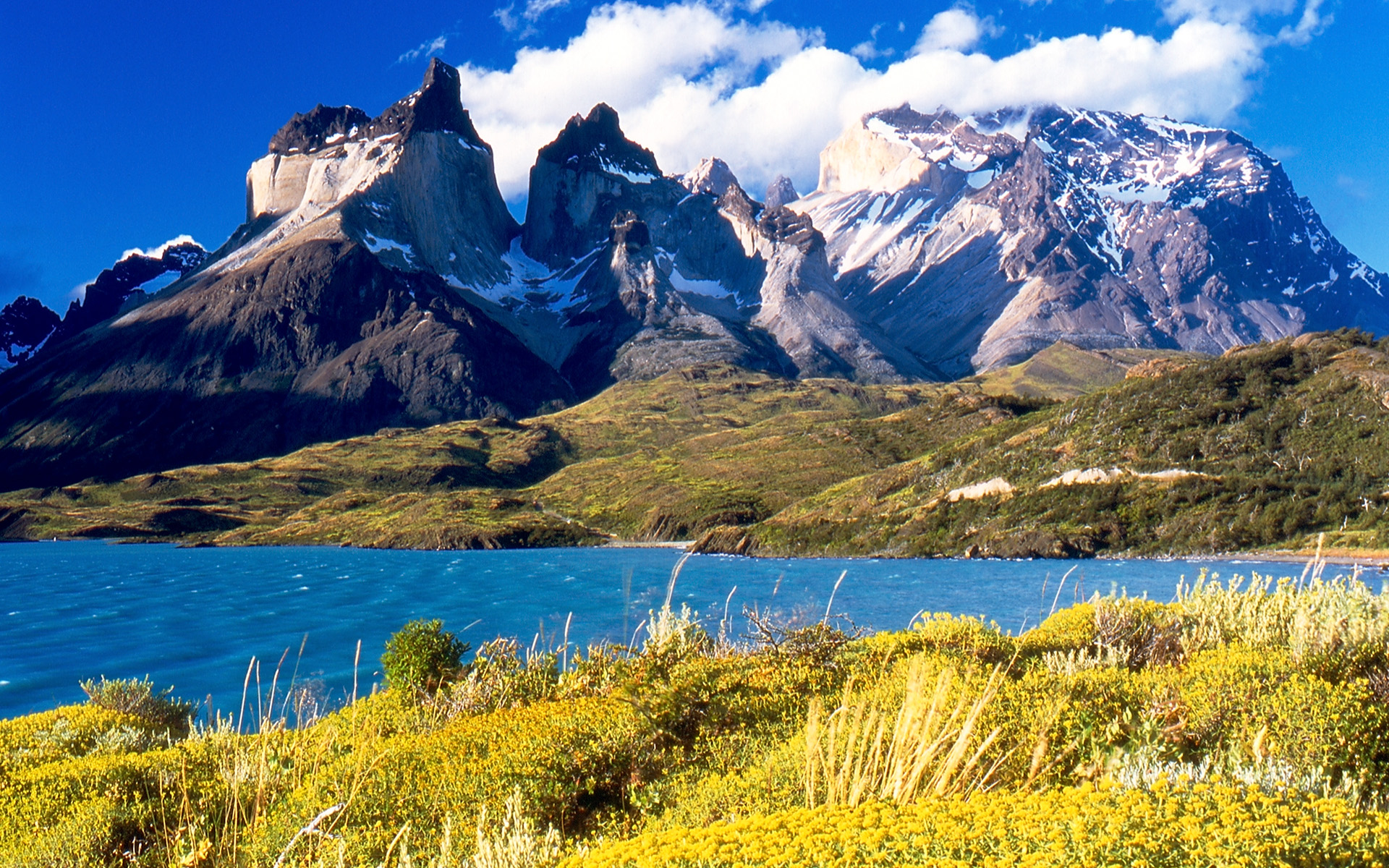
Torres del Paine is a national park in Chilean Patagonia. It is in the southern tiers of the Andes and features mountains, lakes, and glaciers. The rocky Torres del Paine (meaning "Blue Towers" in a mixture of Spanish and local indigenous languages) give the park its name. Other attractions include the Cuernos del Paine mountains, Grey Glacier, Lago Grey, Lago Pehoé, Lago Nordenskjöld, and Lago Sarmiento.
Torres del Paine National Park旅遊指南
城市概覽
Geology The towers are eroded remains of an uplifted region, this created by granite plutons that uplifted overlaying sedimentary layers of which the lowest is a dark red shale. On the southern side the overlying materials have been completely eroded, leaving only several tall, rounded granitic towers - these are the actual towers of the park. On the northern side, some of the original materials remain and as these have different slope and color, form the tips of the "horns" seen in the image above. At times in the distant past the area was extensively glaciated; some glaciers remain on the eastern side of the uplift (to the left in the image) and form icebergs that flow some distance into the large and scenic Lake Pehoé.
History According to the studies made to the Paleo-Indian artifacts found in the surroundings of the park, the area must have been inhabited some 12,000 years ago. The Tehuelche Indians, descendants of the Paleo-Indians gave the name of Paine to the Massif, which meant "blue" in their language. Lady Florence Dixie, in her book published in 1880, gave one of the first descriptions of the area and referred to the three towers as Cleopatra's Needles. She and her party are sometimes credited as being the first "foreign tourists" to visit the area that is now called Torres del Paine National Park. Several European scientists and explorers visited the area in the following decades, including Otto Nordenskiöld, Carl Skottsberg, and Alberto María de Agostini. The park was established in 1959 as Parque Nacional de Turismo Lago Grey (Grey Lake National Tourism Park) and was given its present name in 1970. In 1976, British mountaineer John Gardner and two Torres del Paine rangers, Pepe Alarcon, and Oscar Guineo pioneered the Circuit trail which circles the Paine massif. In 1977, Guido Monzino donated 12,000 hectares (30,000 acres) to the Chilean Government when its definitive limits were established. The park was designated a World Biosphere Reserve by t
如何抵達
By car Warning: The nearest guaranteed gas/petrol stations are in 1 Puerto Natales. There are four main entrances (porterías) to the park.
Ruta Y-156: 1 Laguna Amarga – The main entrance to the park, located closest to the Las Torres complex. Ruta Y-150: 2 Lago Sarmiento – The least visited entrance located near the banks of Lago Sarmiento. Ruta Y-160: 3 Laguna Azul – The northernmost entrance to the park, mostly used by those renting horses for the trails located nearby. Ruta Y-290: 4 Serrano – The most direct route to Puerto Natales (approximately 90 kilometers, 1.5 hours, only partially asphalted) and the closest to administration building and visitor center. It is also possible to enter the park via Ruta Y-180/Portería Laguna Verde. However, the road ends here and it is only possible to further enter into the park on foot or on horse. This entrance is more an option for those reentering the park on an already paid pass, as entrance fees are not collected at Laguna Verde.
By bus Buses run daily from Puerto Natales (two hours), the main connection to civilization. All normal buses pass through Laguna Amarga, where entrance fees are collected and official Conaf maps are given out, before continuing to Pudeto which is the departure point for the catamaran to Paine Grande. At Pudeto those wishing to continue on to the administration building/visitors' center will change to a different bus, regardless of bus company. The following bus companies in Puerto Natales make twice daily trips to the park in the high season, and all follow the same schedule. Note that all buses leave from the bus terminal in Puerto Natales (at the corner Avenida Santiago Bueras and España). Tickets can be purchased either at the bus terminal or at the addresses listed below. Tickets may include an open return, so don't lose the return ticket stub.
Buses Fernandez, Armando Sanhueza 745, +56 61 242313. Buses Gomez, Arturo Prat 234, +56 61 415700. Buses María José, Av. España 1455, +56 61
當地交通
Trail status can be accessed via the informe diario (Spanish only) on the official park website. The main trails at lower elevations are generally open year-round. However, the backside of the Paine Massif Circuit (between Laguna Amarga and Refugio Grey, counter-clockwise) is closed in the wintertime (May–October) due to the absence of park rangers and the difficulty of the terrain. Parts of the W trek (the Francés Valley, the Base of the Towers lookout, for example) are regularly closed in the wintertime due to snow accumulation, even if it is not snowing in other sectors of the park. It is advisable to check the website for the most up to date information. Generally, most visitors to the park access the main trails (that comprise the "W" trek and the Paine Massif Circuit) either by catamaran from Pudeto to Paine Grande or on foot/by shuttle to Hotel Las Torres from the Laguna Amarga entrance. The main trails can also be accessed from the administration/visitor center on foot to Paine Grande, passing Campamento Las Carretas on the way (colloquially called the "Q" trek). The catamaran Hielos Patagónicos operated by Hipsur runs between Pudeto and Refugio Paine Grande. One-way and tickets cost 23,000 pesos for Chilean citizens and US$35 for foreign citizens respectively, backpack and luggage transport costs an additional 4,000 pesos and must not exceed 50 kilograms. From Laguna Amarga a van runs to and from Hotel Las Torres four times a day in order to connect the Las Torres to the main bus route. The price is 3,000 pesos one way. The shuttle typically leaves at 14:00 to get passengers back to their buses by 14:30 to return to Puerto Natales. Backpackers can wait at the Refugio Central and get a hot lunch or relax while waiting. The Grey II runs between Hostería Lago Grey and Refugio Grey and must be booked in advance (70,000 pesos single ticket for adults in high season). The rest must be done by foot.
必看景點
1 Torres del Paine. The lookout, Base de las Torres, is a 45-minute hike from Campamento Torres 2 Valle Francés. Accessed from Campamento Italiano, a three-hour hike one way. 3 John Gardner Pass. Between Camping Los Perros and Campamento Paso, the John Gardner Pass is the point between the Valle de Los Perros (Valley of the Dogs) and the backside of the Circuit, and Glacier Grey. 4 Glacier Grey. The Glacier Grey can be seen via a short hike out onto a sandbar from Guardería Grey, from the John Gardner Pass, or from Refugio Grey on the "W". 5 Lago Sarmiento. A large pretty lake with distinctive white banks, a result of calcium deposits.
體驗活動
Torres del Paine is world-renowned for trekking, with routes ranging from short day walks to multiday circuits. Detailed stage descriptions can be found in Hiking in Torres del Paine.
W Trek - The classic 4–6 day route visiting Grey Glacier, the Francés Valley, and the Torres del Paine viewpoint. O Circuit - A 7–10 day full circuit around the massif, including remote valleys and the dramatic John Gardner Pass. Day
城市概覽改寫自 Wikipedia,旅遊指南來自Wikivoyage (CC BY-SA)。照片來自 Wikimedia Commons.