
Tondo
Philippines · Asia
關於Tondo
Tondo is a large, culturally diverse district of Manila. Being near to Binondo, many Filipino-Chinese roam around this area, and also have different kinds of businesses situated in this area. Food tripping in this area would be a great idea due to the abundant number of Chinese food stalls and restaurants lying in this area.
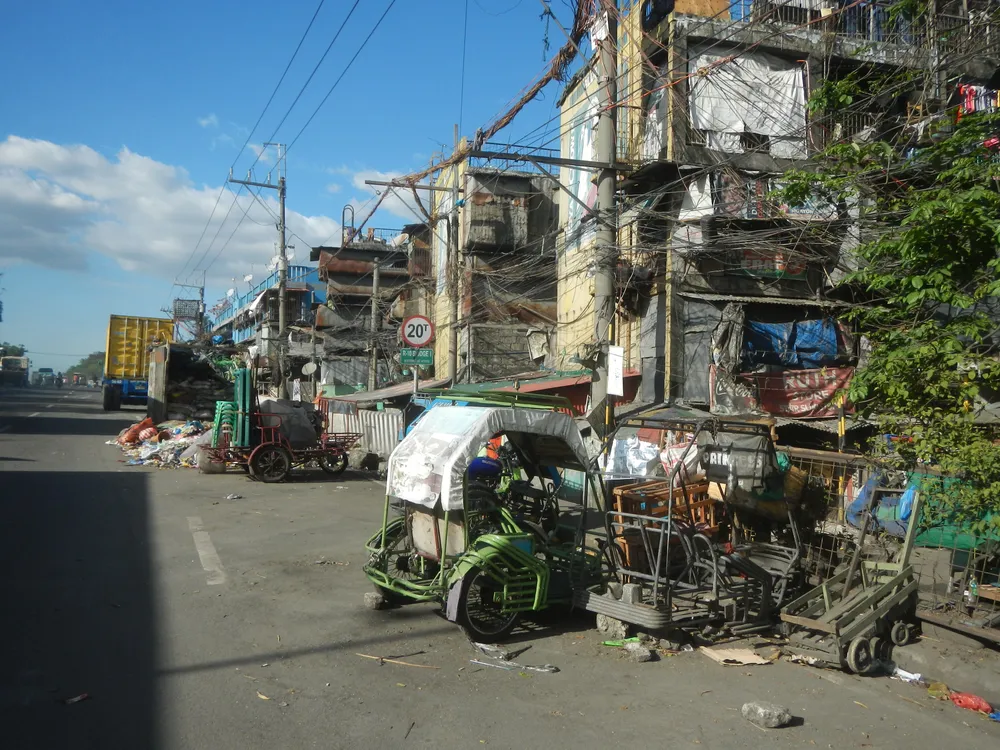
The average traveller can be easily taken away by the constant bustle and haggle in Divisoria, Manila's major bargain market. Tondo is more of the shopping center for bargain hunters; a walk or a pedicab ride will allow you to see the true face of the district. Another way of experiencing Tondo is touring slums, rather not for the faint of heart with the district's reputation for gangs and grit, but a local guide will help you get around and meet locals.
Tondo旅遊指南
城市概覽
Slums, poverty and gangs is the first impression of Tondo by many people, and that's why this part of Manila is perhaps off-the-beaten-path, except for the Divisoria market popular with bargain hunters. The lack of historical sites of tourist importance also adds to the problem, but trying to dig down a bit can lead you to hidden spots. Tondo has a population of over 655,000 people (as of 2020) in 9 km2 (3.5 sq mi) of land, making this district the densest in Manila; it is also reputed as one of the world's most densely populated neighborhoods. The population density is well reflected by the scarcity of high-density housing for poorer residents. The income gap is also well illustrated: most locals live on simple houses or low-density apartments, while mid-class people inhabit the towering condominiums that represent the district's ongoing gentrification. Tondo's ethnic composition and culture are diverse, and waves of immigration creates the district's distinctive cultural blend. Southeastern Tondo and Divisoria is a northern extension of Binondo, so find many Filipino Chinese businesses and schools around. Anywhere, you will find Visayans, Ilocanos, Kapampangan, and other native ethnic groups. Muslim Filipinos are rather a tiny minority.
"I work a lot in the slums of Tondo, Manila, and the life there is poor and very sad. And I've always taught to myself to look for the beauty of it and look in the beauty of the faces of the children and to be grateful." — Catriona Gray (Miss Universe 2018)
History Tondo was the center of the namesake kingdom, the Kingdom of Tondo, one of the pre-Hispanic polities found in historical finds. The old polities fell to the Spanish colonizers, and Tondo became a Spanish overseas province, until its dissolution, where Tondo's northern halves became part of Bulacan and Rizal. Tondo became a center for Filipino revolutionaries, and is home to Andres Bonifacio who led the Philippine Revolution from 1896 and 1897, where he was executed b
如何抵達
By train The Philippine National Railways' main terminal and headquarters, 1 Tutuban-PNR Station, Mayhaligue Street corner Dagupan Street, ☏ +63 9175827192, [email protected]. (updated Jan 2019) is at the Tutuban area. Most visitors from southern Metro Manila will come by train, and the station leads into Divisoria. The original train station is found where the Tutuban mall complex stands. Trains from Bicol Region arrive at Tutuban-PNR Station, but service is suspended indefinitely as of 2017. Metro Commuter Line trains to and from Muntinlupa, Malabon and Calamba trains begin service at 5AM and ends at 8PM, but trains can get stuffy on morning, noon, and evening rush hours. Pickpockets also lurk on the trains, so wear backpacks at the front and avoid placing valuables on rear pockets. The nearest LRT stations are LRT Line 2 (LRT-2) Recto station, and LRT Line 1 (LRT-1) Blumentritt station. An LRT-2 extension to Divisoria is proposed, but for now, going to Tondo through the LRT will involve a transfer to a jeepney bound for Divisoria.
By jeepney Jeepneys, both classic and modern, connect Tondo with the rest of Manila, as well as other cities in Metro Manila. Routes converge around Divisoria, near Tondo's historic center. Within Manila:
Divisoria-Quiapo: Connects the commercial center of Quiapo via Recto Avenue. Fare: ₱9 regardless of boarding point. Route used to be served by electric tricycles between 2016 and 2019. Outside Manila:
Gasak-Divisoria: Route starts at Malabon, passing through Navotas and northern parts of Tondo like Balut, Vitas, and Gagalangin. Route operated by modern, air-conditioned jeepneys as of 2020. Fare: ₱28.
當地交通
Primary ways of getting around Tondo and San Nicolas is by jeepney, tricycle or pedicab, or on foot. Bus service is limited to Road 10, which separates the districts from the Port of Manila. You can walk, but this is not advisable if you're alone. Car travel is not advisable. Parking is mostly available only around Tutuban Mall; on-street parking is nearly nowhere to find, and there's the risk from smash-and-grab thieves and delinquent youths. Streets are more often than not narrow, and the otherwise wide Road 10 do get congested with trucks coming in and out of the port.
必看景點
Birthplace of Andres Bonifacio. (updated Jul 2020) 1 Katipunan founding site, 72 C.M. Recto Avenue. (updated Jul 2020) 2 Plaza La Liga Filipina, Ilaya Street cor. Raja Matanda Street. Open 24 hours. A small park at the now-demolished house where the La Liga Filipina, a Filipino revolutionary organization led by Jose Rizal, Andres Bonifacio, and Apolinario Mabini, were established. Free. (updated Sep 2023) 3 Plaza Moriones, Moriones Street. A linear park placed on the median of Moriones Street, it is dedicated to the Spanish Governor-General Domingo Moriones y Muralla, who designed Manila's sewerage system. It also has a role in Philippine politics, being the location of the first Philippine Labor Day celebrations, and it is designated a "freedom park" where protesters are free to assemble peacefully. Also in the park is a monument to Honorio Lopez, a revolutionary from Tondo. (updated Jul 2020) 4 Seng Guan Temple, Nara Street (near Divisoria and Tutuban Mall). 6AM-10PM. Serving as the center of worship for the Buddhists, is the Mahayana styled Seng Guan Buddhist Temple. This three-floor temple crowned with beautiful golden stupas is also known as “Temple of Thousand Buddhas”. The second floor of the temple is famous for the carved murals that depict different scenes from Buddha’s life and the three silk-mache gold Buddhas. It also has special rooms for chanting sutras and prayers. There is also a congregation hall (generally closed to public) with a 10-foot Buddha statue. 5 St. Stephen's Parish Church, Masangkay Street. Anglican church. 6 San Jose de Trozo Parish Church - Santa Cruz, Manila City (Archdiocese of Manila), Masangkay St. It has improved a lot throughout the years. The Church’s patron saint is St. Joseph because the people of the area used to be lumberjacks. Historical the area was called Trozo, because of the lumbers found in the place. As of 2022, the parish priest is Fr Peterson Tieng, LRMS. He gives passionate homilies and formation talks. They a
體驗活動
Slum tours
Tondo is one of the few places to offer tours of its sprawling slums. The Smokey Mountain tenement which was a landfill that now houses apartments serving as residences for some of Manila's urban poor. The slum tourism industry is not formally organized; just ask a local to serve as your guide to get around, meet locals and see the everyday life in houses, schools, shops, and local food stops. Touring alone is inadvisable, as you are just exposed to the constant threat of street thugs finding their next victim.
Santo Niño de Tondo Festival Tondo holds a feast dedicated to the Santo Niño (Holy Child) every third week of January. Festivities are centered on Tondo Church, which hosts an image of the Santo Niño. The peak of the fes
城市概覽改寫自 Wikipedia,旅遊指南來自Wikivoyage (CC BY-SA)。照片來自 Wikimedia Commons.