
Swakopmund
Namibia · Africa
關於Swakopmund
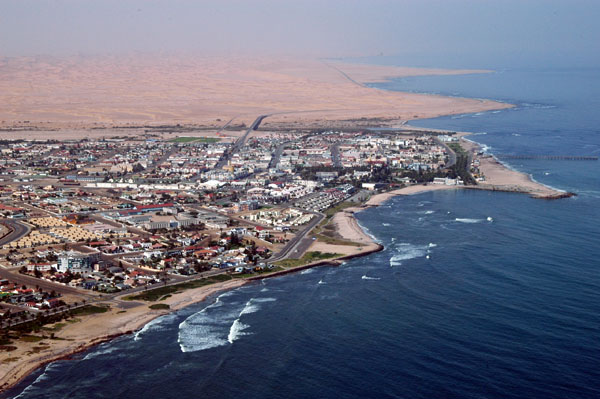
Swakopmund, known as Swakop, is in the Erongo region of Namibia. It is the country's biggest coastal town and a resort for Namibians on holiday. The city's German origins are quite pronounced in beautiful old German colonial buildings throughout the city, making an even starker contrast for this town sitting at the edge of the Namib Desert. Swakopmund is like a German North Sea town with an African flair (or vice versa).
Swakopmund旅遊指南
城市概覽
History The first European explorers of the area, Dutchmen Sebastian van Reenen and Pieter Pienaar described the area in 1793 as one with lush vegetation and elephants and rhinos. Nowadays the area can be described as ocean on one side and desert on the other, with some shrubs as the only natural vegetation. About a century after the Dutch exploration, the area was a colony of the German Empire, and was chosen as a second port for German South West Africa after Lüderitz. Walvis Bay would have been much better suitable but it was already in the hands of the British when the Germans established their colony. The architects decided that Swakopmund should resemble the German homeland as much as possible, wherefore the city now looks as it does. The boom period of the city continued until the outbreak of World War I. This interrupted the construction of the massive pier, nowadays one of the city's main sights. After the war, the colony was taken over by the Union of South Africa, and all trade was done via Walvis Bay, which was now no longer foreign territory. Swakopmund declined but from the 1930s established itself as a resort town, helped by its pleasant climate and the abundance of fish in the ocean. Today it's the fourth most populous city in the country, with 45,000 residents (as of 2011), and popular among domestic and foreign holidaymakers and pensioners. It still has a sizeable German community.
Climate
Swakopmund has a mild desert climate, with the temperature varying little during the year. The town sees only about 20 mm of rain around the year; instead thick fog is a frequent occurrence. This is also why the Namibian coast is infamous for its shipwrecks. In addition to bringing needed moisture for the vegetation, the fog is also liable to lower the temperature to below +10°C in the winter.
Watch Swakopmund was used as the setting for The Village in the 2008 production of The Prisoner by AMC and ITV. Its quaint buildings and unusual appearance made a
如何抵達
By car The best way to get to Swakopmund is by road from Windhoek. The B2 is the main road from Windhoek (362 km inland), and takes 4–5 hours by car. Walvis Bay, the closest major city, is 35 km to the south, also next to the B2. The road is paved and in good condition. From elsewhere, you need to take a "C"-road. C34 goes north along the coast from Skeleton Coast National Park, and is a dangerous drive due to the aforementioned thick fog. There are also two roads that are more of dirt tracks, but interesting if you want to see some of the Namibian outback and have a 4WD vehicle; C28 coming in from Windhoek via the Namib-Naukluft National Park and C14 connecting to Walvis Bay.
By plane Swakopmund does have an airport, but it's just used by the local skydiving club and for some charter flights. The closest airport for with passenger traffic is 35km away near Walvis Bay, and you can fly there from Johannesburg and Cape Town with South African Airways. Some hotels and guest houses will provide a shuttle service to/from the Walvis Bay airport. Otherwise, there are a couple of local shuttle services — The Flying Coffee Pot (☏ +264 811 287455) and Raiwin Shuttle Service (☏ +264 81 273 9309) — that do the trip between Swakopmund and the airport for around N$200. Bookings can be made through the shuttle service's website. If you have more money to spend, there are numerous small aircraft charter operators in Namibia, and flying from destination to destination on a tour through Namibia is an effective way to minimize the time spent travelling the long distances.
By minibus Minibuses operate from Windhoek almost every 2-3 hours, ask the taxi drivers where the buses leave. There are multiple minibus ranks in Windhoek for different destinations, so make sure you find the right one. For about N$120 you can have a ride in a minibus. The ride will take about 4-6 hours. Pay immediately and try to get yourself a seat next to the driver for a bit more space.
By bus
Althou
當地交通
As with other Namibian cities, there is no public transport in Swakopmund. But the city is small enough to get around easily on foot. All the major attractions and facilities are in the centre. It´s hard to get a taxi in city centre (there are no taxis on a Saturday after 19:00), but once you get one it takes you wherever you want for the same rate as the Windhoek Taxis. A trip to Walvis Bay shouldn´t be more than N$40.
必看景點
Architecture
Much of the downtown is built in early 20th-century German style.
1 Woermannhaus, Bismarck Street. A German half-timbered house in the colors of the desert with a 25m high tower and arcaded inner yard. Built by the German trading company Woermann in 1905 as their headquarters for German Southwest Africa. In 1972 the building was declared a national historic landmark and nowadays it functions as a public library. (updated Apr 2015) 2 Swakopmund Jetty. Jutting 300 m out in the Atlantic Ocean. Originally it was smaller and built out of wood. Later on, the current concrete jetty was built, but after WWI it fell into disuse. Renovated in 2005, it is a popular attraction, especially for viewing the sunset. (updated Apr 2015) 3 Old railway station and casino, Bahnhof Street. Built in the Wilhelminian style in 1902 as a railway station for the new line to Windhoek, it nowadays hosts the Swakopmund Hotel, exhibition centre and casino. 4 Altes Gefängnis. Built in 1909, it still functions as a prison. However, it's built in the same style as much as the rest of downtown (much prettier than a modern prison) and has been a national historic landmark since 1973. (updated Apr 2015) 5 Haus Hohenzollern, Moltke and Brücken street. An Art Nouveau building constructed in 1906 as a luxurious hotel, today it is an apartment building. 6 State House (Kaiserliches Bezirksgericht), Am Zoll Street. Built as a courthouse in 1902, nowadays it is the Swakopmund residence of the Namibian president. 7 Lutheran Church. Built by the Germans in 1912, this Evangelical-Lutheran church is another building which looks like it has been transplanted from somewhere in Germany. 8 Barracks (Kaserne), Bismarck Street. Built in 1903 as housing for the troops of the engineer corps who constructed much of the early infrastructure. The lobby is decorated with German coats of arms. Nowadays the building functions as a youth hostel. 9 Lighthouse. The 25.6m-high lighthouse is one of the most vi
體驗活動
Swakopmund is Namibia's adventure capital, and there's a great selection of activities to try out on land, sea and in the air. Tours and activities may also be booked once you're in Swakopmund.
Air
The impressive Namib Desert (the oldest desert in the world, with the tallest sand dune in the world) around Swakopmund and the Skeleton Coast to the north can be appreciated in their entirety from the air, from a hot air balloon, a helicopter or a light plane. There are several kinds of flight tours are available, ranging from a few hours to a few days. Some flights enabl
城市概覽改寫自 Wikipedia,旅遊指南來自Wikivoyage (CC BY-SA)。照片來自 Wikimedia Commons.