
Q772211
Philippines · Asia
關於Q772211
Intramuros (Latin: within the walls), also known as the Ciudad Murada ("Walled City" in Spanish) because of its most famous feature: a nearly 5-km-long circuit of massive stone walls and fortifications that almost completely surrounds the entire district, is the historic centre and oldest district of Manila, the capital city of the Philippines.
Q772211旅遊指南
城市概覽
From the city's foundation in 1571 to the end of Spanish rule in 1898, Intramuros was Manila. The Spanish conquistador Miguel López de Legazpi laid the foundations of the new capital on the former site of Maynilad, a palisaded riverside settlement ruled by a native chieftain. To protect the inhabitants from attack, in the late 1500s construction began on a series of stone walls and fortifications that would eventually enclose a pentagonal area approximately 0.67 km² in size, within which lay a tight grid-like system of streets and a main square surrounded by government structures. The defensive curtain was more or less completed by the 1700s, although improvements and other construction work continued well into the next century. Within the protective walls rose a city of stone palaces, churches, monasteries, convents, schools, and fine courtyard houses. In the centuries that followed, Manila (meaning Intramuros) served as the capital of the Spanish East Indies - the centre of commerce, education, government, and religion in Spain's most distant imperial possession. Except for a brief period under British rule (1762-1764), Intramuros remained a Spanish city until 1898, when the US took control of the Philippines at the end of the Spanish-American War. In 1945, during the fierce Battle of Manila between American, Filipino and Japanese forces, Intramuros was almost completely destroyed. Instead of rebuilding on the same site, many of the religious orders and educational institutions that once resided in the walled district packed up and moved elsewhere. Although steps were taken to protect the city's historic character, vague laws and poor enforcement led to many unsightly modern buildings being built upon the ruins of the old. In 1979, the Intramuros Administration was established and stronger measures were introduced in order to preserve what was left. Many of the city's ancient gates and most of the walls have since been restored. On the other hand, there has
如何抵達
By taxi For visitors who don't mind shelling out a little extra - and putting up with rush-hour traffic jams - Manila's relatively inexpensive taxis are probably the easiest and most direct way of reaching Intramuros from elsewhere in the city. The current flagdown rate is ₱40, and the fare goes up in increments of ₱3.50 every 300 metres.
By train The nearest railway station is Central Terminal (LRT-1). Though within sight of the eastern walls, the station is a pretty long walk from the western part of Intramuros (where many of the major sights are located), so tourists headed in that direction might consider covering the rest of the journey by taxi.
By water bus The Pasig River Ferry used to stop at Plaza México station, not far from the ruins of the Intendencia (Aduana) building, but according to reports the service has been suspended for an indefinite period. If operations resume, the ferry will likely use this same stopping point.
當地交通
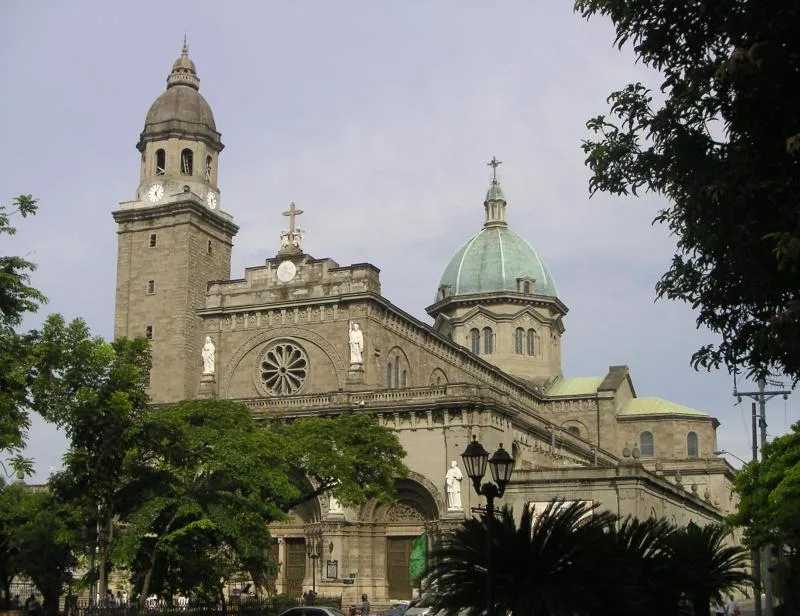
It's hard to get hopelessly lost in Intramuros, thanks to the district's orderly street plan. General Luna (also known by its old name, Calle Real del Palacio) is the closest thing Intramuros has to a main street and gives visitors easy access to most of the major attractions, including San Agustín Church and Manila Cathedral. Follow this street all the way to its northwestern tip and you'll find yourself in front of Fort Santiago; go the other way and you'll eventually end up in Rizal Park, which is just over the border in the nearby Ermita district. If you do lose your bearings, don't panic. Except for a small section near the river, the entire district is surrounded by walls - so there probably isn't much of a chance that you'll inadvertently end up in the wider city beyond. A quick look at a map (and perhaps a little help from passers-by) should easily put you back on track.
By calesa - First used on the streets of Manila in the 18th century, these horse-drawn carriages can usually be found waiting for passengers near Fort Santiago. A nice, old-fashioned way to get around Intramuros. To avoid getting ripped off, it may be a good idea to ask about the route and confirm the price of the trip before setting out. On foot - Walking from one attraction to another is a popular way to get around Intramuros. Just mind the cars: there are almost no sidewalks to speak of, so pedestrians usually share space with automobiles. It is even possible to walk on some sections of the old city walls.
必看景點
Walls, gates, and fortifications
Except for a small open stretch near the River Pasig, Intramuros is completely surrounded by the massive stone walls that gave the district its name. Starting from the northwestern end of the fortifications and moving anti-clockwise (Note: This is not a comprehensive list!):
1 Fort Santiago, Santa Clara (on the NW end of Plaza Moriones), ☏ +63 2 527-1572. 8AM-6PM daily. The former military headquarters of the Spanish colonial government. Although the fort sustained very heavy damage during the 1945 Battle of Manila, several key portions of the compound were subsequently restored - including its iconic gate with a wooden relief featuring Santiago Matamoros (St. James the Moor-slayer), the patron saint of Spain. It is now considered a major landmark and one of Manila's most popular tourist attractions, partly because José Rizal - the national hero of the Philippines - was imprisoned here prior to his execution on 30 Dec 1896. The Rizal Shrine (see Museums, below), a small museum dedicated to his life and work, is housed in a restored section of one of the fort's former barracks. ₱75, ₱50 students/children. Postigo del Palacio, Santa Lucia (a short distance from the back of the Palacio del Gobernador). Built in 1662, renovated 1782-83. On 30 Dec 1896, national hero José Rizal was taken through this gate en route to the place of his execution, in what is known today as Rizal Park (see related entry on the district sub-page for Ermita). Puerta de Santa Lucia Baluartillo de San Jose and Reducto de San Pedro Baluarte de San Diego, Santa Lucia cor. Muralla. Dating from the 17th century, this formidable bastion surrounds the remains of the round fort of Nuestra Señora de Guia, the first stone fort built in Manila. Severely damaged during the Second World War, the Baluarte de San Diego was restored in the 1980s and is now a major tourist attraction. Puerta Real and Revellin de Real del Bagumbayan Baluarte de San Andres Baluarte de Sa
體驗活動
Club Intramuros Golf Course, Bonifacio Drive cor. Aduana Street, Port Area (30-45 min from the airport via Roxas Blvd). A few years after the Americans took over from the Spanish in 1898, the fetid, swamp-like moat around Intramuros was drained and filled in. The newly reclaimed land was later covered with grass, spiced with a few sand pits and sprinkled with water traps. Result: a 4,326 yd, 18 hole, par 66 greensward that wraps around the city's ancient walls and makes for an interesting (if rather short) golfing exper
城市概覽改寫自 Wikipedia,旅遊指南來自Wikivoyage (CC BY-SA)。照片來自 Wikimedia Commons.