
Prince Edward Island
Canada · Americas
關於Prince Edward Island
For the South African sub-Antarctic island, see Marion Island, for Matecaña International Airport (IATA: PEI), see Pereira#By plane.
Prince Edward Island (often abbreviated PEI) draws visitors from around the world who come for its beaches, golf courses, pastoral beauty, relaxed pace, and, of course, to see the island that inspired Lucy Maud Montgomery to write the Anne of Green Gables books.
Prince Edward Island is Canada's only exclusively insular province, and also the smallest one by both area and population, with only 150,000 inhabitants. A rich farmland, the island was one of the first parts of Canada to be settled by Europeans.
Prince Edward Island旅遊指南
城市概覽
"The island", as locals call it, is well-known for its beautiful sandy beaches, dunes and potato fields. It is also the home of the gregarious Anne Shirley from Lucy Maud Montgomery's classic Anne of Green Gables. PEI has three counties:
Prince, the western third of the province Queens, the central third of the province Kings, the eastern third of the province
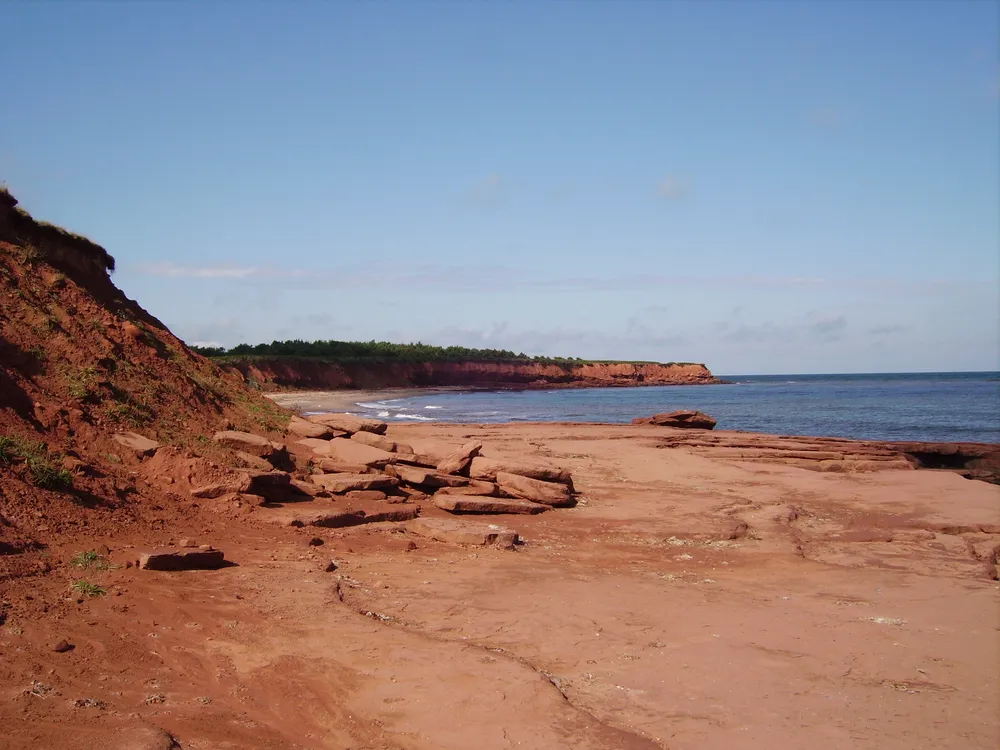
History It was part of the traditional lands of the Mi'kmaq First Nation (Indigenous) people. They named the island Epekwitk, meaning 'cradled on the waves'; Europeans represented the pronunciation as "Abegweit". The Mi'kmaq's legend is that the island was formed by the Great Spirit placing on the Blue Waters some dark red crescent-shaped clay. There are two Mi'kmaq First Nation communities on the island today. In 1604, France laid claim to the lands of the Maritimes, including the island they called Île Saint-Jean, establishing the French colony of Acadia. By the early 1750s, 5,000 Acadians lived on the island. After French forces were defeated at the siege of Louisbourg on Cape Breton Island in 1758, the British took over the island, and began to deport most of the Acadians from the island, as they had done to those living in what are now Nova Scotia and New Brunswick. Many Acadians died in the expulsion en route to France. The French ceded the island and most of New France to the British in the Treaty of Paris of 1763. During and after the American Revolutionary War, from 1776 to 1783, the colony's efforts to attract exiled Loyalist refugees from the rebellious American colonies met with some success. A large influx of Scottish Highlanders in the late 1700s also resulted in the island having the highest proportion of Scottish immigrants in Canada. This led to a higher proportion of Scottish Gaelic speakers and thriving culture surviving on the island than in Scotland itself, as the settlers could more easily avoid English influence overseas. In 1798, the British named the island colony for Prince Edwar
如何抵達
By car Being an island, PEI has limited access by car. The monumental Confederation Bridge, almost a visitor attraction in itself (viewing stations on the New Brunswick side offer good photo opportunities), crosses the Northumberland Strait between New Brunswick (NB) and PEI. It's reached from the mainland on Route 16 near Aulac, and stretches 13 km across open water to the island. The bridge arrives on Prince Edward Island as Highway 1. Route 16 and Highway 1 are part of a branch of the Trans-Canada Highway. The toll of $50.25 (increased in 2022 from $47.75 toll for a car, $19.00 for a motorcycle at 2019 rates, 2-axle vehicle, $8.25 for each additional axle), is collected on the PEI side when returning to the mainland. Travel across the Bridge as a pedestrian or cyclist is possible via the passenger shuttle service which travels between Borden-Carlton, PEI, and Cape Jourimain, NB. The price for the shuttle is $4.50 for pedestrians and $9.00 for cyclists (this price includes the bicycle as luggage). The first article of luggage is free and every additional piece of luggage is $4.00 (not including luggage attached to a touring bicycle). Apprehensive drivers (drivers who wish not to personally drive across the bridge for any reason, often a fear of heights) may choose to pay a fee of $40.00 to have a bridge employee drive their vehicle across the bridge. There is no stopping allowed on the bridge and is open 24/7 year round, with the exception of severe wind conditions which may close the bridge for an indeterminate amount of time.
By boat There are a number of car ferries to PEI:
Northumberland Ferries Limited, ☏ +1-888-249-7245, crosses from Caribou, Nova Scotia to Wood Islands about once every hour and a half, from 6:30AM to 7PM (a return trip is $21 per passenger, $18 for seniors and free for children, $82 per car or camper up to 20 ft (6.1 m), $43 for motorcycles, and $21 for bicycles (as of Sep 2021). Same as the toll bridge, only the way out from PEI is
當地交通
Non-metered taxi service is available within the city limits of Charlottetown and Summerside, as well as in most large communities. Most taxi companies are willing to provide transportation to rural areas of the island as well, but be prepared to pay a higher rate for this service. Kari ride sharing operates in the whole island.
The city of Charlottetown operates a public transit system that provides bus transportation at a cost of $2.25 to various locations around the city. Although the service does not extend very far beyond city limits, it does provide fast, reliable transportation to most locations within them. There is little intercity public transport: T3 on line Charlottetown-Kensigton-Hunter River-Charlottetown In the summer cycling is popular. Although most roads do not have wide shoulders or designated bike lanes, drivers tend to be quite courteous to cyclists. The landscape consists mostly of rolling hills; there are few steep hills to climb. Additionally, the Confederation Trail stretches from one end of the island to the other. Built on a disused rail bed, the trail has low grades and is reserved for cyclists and pedestrians. Cycling maps, sample itineraries and other cycling resources are available from Atlantic Canada Cycling. Outside of walking, hitchhiking or cycling, a vehicle is almost mandatory to travel the island, especially in winter.
必看景點
Tourism in PEI often focuses on beach, seafood, music and the Anne of Green Gables House (in Cavendish), which especially appeals to visitors from Japan, for whom this is the third or fourth most popular destination in North America (after the Grand Canyon and Banff, Alberta and often ahead even of Niagara Falls). L. M. Montgomery's book, Anne of Green Gables, has become a major part of the Japanese school curriculum, and as such the Green Gables historic site is a major attraction for Japanese tourists. Cape Bear, at the southeastern tip of the island, is formed from high cliffs that offer a good location for photography and viewing seals. During World War II, the lighthouse at Cape Bear was used to spot German U-Boats. Cape Bear was also the first land station in Canada to receive an SOS from the Titanic in 1912. The Ghost Ship of the Northumberland Strait is a legendary ghost ship believed to sail the Northumberland Strait by nightfall engulfed in flames. Many ships ventured out on rescue missions to this burning ship. Reportedly, the ship always receded from view. Witnesses across the island will testify to sightings of this phantom ship. The cliffs surrounding High Bank in Kings County in eastern PEI provide sweeping views along the Northumberland Strait of Nova Scotia and Pictou Island. Malpeque Harbour is a bay in Prince County. It is the source of famous oysters, and of many postcards and posters of the picturesque fishing boats, colourful barn-shaped boat houses, and neatly stacked lobster traps. Arrive in late afternoon or early morning for the best light on the water. In the 1700s M
城市概覽改寫自 Wikipedia,旅遊指南來自Wikivoyage (CC BY-SA)。照片來自 Wikimedia Commons.