
Negishi
Japan · Asia
關於Negishi
On the western coast of Tokyo Bay directly south of Tokyo, Yokohama (横浜) is the second largest city in Japan and one of the cities most used to seeing foreigners.
Negishi旅遊指南
城市概覽
First a fishing village, Yokohama developed into a bustling port city following the establishment of foreign trade after the opening of Japan in 1854. It was the site where Commodore Matthew Perry landed and forced Japan to sign the Kanagawa Treaty ending over 200 years of isolationalism by the Tokugawa Shogunate. At the forefront of the Meiji restoration, the first train line in Japan connected Tokyo and Yokohama. However, Yokohama was devastated by the Great Kanto Earthquake of 1923 and again by the firebombings of World War II, and never really regained its prominence. It remains a maritime city to this day and retains an international flavor.
Tourist Information The city has a multilingual Official Visitors Guide site.
如何抵達
Yokohama is half an hour away from Tokyo, and effectively forms a part of the giant conurbation.
By plane Yokohama does not have its own airport. You can reach Yokohama from Tokyo's two main airports. Some Narita Express trains from Narita Airport go through to Yokohama (1½ hours, ¥4290 or free with JR Pass). Limousine Buses run frequently from Narita to the Yokohama City Air Terminal (YCAT) in 2 hours (¥3600). The cheapest access from Narita Airport involves a Keisei train. The Keisei Main Line train, with one across-the-platform transfer at Aoto, will cost ¥1500 to Yokohama. The Sky Access line train will cost ¥1690. Most Sky Access trains run to Keisei Ueno, but there are a handful each day which run through to Yokohama (and beyond; generally to Kanazawa-Bunko) on the Keikyu Main Line. From Haneda Airport, take the Keikyu Line's Express (急行) to Yokohama station in 30–35 minutes for ¥480. The Express has several variants: If the train's destination is Shin-Zushi (新逗子) or Kanazawa-Bunko (金沢文庫), then you can stay on the train for the entire trip. If the train goes to another destination, it's likely to continue on into Tokyo so you will need to change at Keikyu-Kamata station to the next main line limited express train going in the other direction.
By train
The overwhelming majority of visitors to Yokohama arrive from Tokyo by train. A multitude of train lines connect the two cities at roughly equal prices, but some of the more convenient options are:
Tokyu Toyoko Line (東急東横線) from Shibuya to Yokohama Station. A trip from Shibuya to Yokohama takes as little as 26 minutes on the fastest service; at a cost of ¥280 this is the cheapest trip from metro Tokyo. Chinatown, the terminus of the MM21 line, is another 10 minutes away (Motomachi-Chukagai, ¥220 from Yokohama or ¥500 from Shibuya). Up to eight kyūkō (急行) and tokkyū (特急) trains per hour. The Toyoko Line station in Shibuya is deep underground, due to its connection with the Tokyo Metro Fukutoshin Lin
當地交通
Yokohama is not a very automobile-friendly place, especially for foreigners. Public transit and walking works best. The official guide site has some maps in English.
By train The Minato Mirai 21 subway line from Yokohama station down the harborfront to Chinatown is the best method of accessing the main tourist haunts. The main subway line is useful primarily for transfers between central Yokohama and the Shinkansen station. JR Negishi Line (根岸線) is also available for Chinatown and Minato Mirai Area. All Negishi Line Trains with the blue line are direct service via the Keihin-Tohoku Line. For suburban areas, Yokohama has a subway and extensive commuter rail lines that crisscross the city from every direction and to all neighboring cities. Yokohama Subway (横浜市営地下鉄) has two lines: the main Blue Line from Azamino to Shonandai and the short Green Line from Hiyoshi to Nakayama. You can get around Yokohama easily using the subway lines.
By bus Akai Kutsu Bus is a sight-seeing bus around Minatomirai, Chinatown and Motomachi. It looks like an old red bus and runs every 20 minutes on the main loop. A ticket costs ¥220, and a 1 day pass costs ¥500.
By boat The "Sea Bass" boat operates between JR Yokohama station (east exit), Minato Mirai and Yamashita Park, and is one of the nicest ways to get around on a sunny day. The fare is ¥350-700 depending on the distance.
By human power Velo taxis called "Cyclopolitain" (シクロポリタン, shikuroporitan) are widely available within the harbor area, while rickshaws make their rounds within Chinatown.
On foot Central Yokohama is comparatively compact and the Chinatown/Yamashita Park area is best explored on foot.
必看景點
1 Marine Tower, 15 Yamashitacho, Naka-ku. Considered by some to be the tallest on-land lighthouse in the world. Built to commemorate the 100th anniversary of Yokohama's port opening. In clear conditions, visitors can see Mount Fuji from the 100-metre high observation deck. Adults ¥750. (updated Jan 2020) 2 Hikawa Maru (氷川丸), Yamashita Park. Yamashita-cho, Naka-ku. Tu-Su 10:00-17:00. This passenger liner made 238 voyages across the Pacific to Seattle and Vancouver between 1930 and 1960, and served as a hospital ship during World War II. The ship is also used for movie and TV location shooting including the 1997 film Moonlight Serenade and the 2005 NHK drama Haru to Natsu. Adult ¥300, senior ¥200, child ¥100.
3 Landmark Tower, MM21 Minato Mirai Station (Minato Mirai 21 district). Su-F 10:00-21:00, Sa 10:00-22:00. The Landmark Tower was the tallest building in Japan until the construction of Abeno Harukas in Osaka. It continues to be the tallest in Yokohama. The observation platform on the 69th floor provides good views all the way to Tokyo and Mt. Fuji can be seen on clear days. The elevators are said to be the fastest in Japan. For a classier experience, try the cocktail lounge on the 70th floor (drinks ¥1000+ each) or eat dinner on the 68th (see below). Adults ¥1000. (updated Oct 2025) 4 Ōsanbashi Pier (大さん橋), 1-1-4, Kaigandori, Naka-ku, ☏ +81 45-211-2304. 24/7. Ōsanbashi Pier is the main international pier at the Port of Yokohama where cruise ships dock. Architecturally renovated with an abstract modern style in 2002, it provides a view of the Minato Mirai skyline. The rooftop garden is open to public and is very beautiful, especially during sunset. Free. (updated Jan 2020) 5 Keiō University - Hiyoshi Campus (慶應義塾大学, Keiō Gijuku Daigaku). A campus of the oldest university in Japan. It is known for its campus' towering maidenhair trees, turning a lovely yellow in the fall. The Hiyoshi tunnels are underneath. Hiyoshi Tunnels (旧日吉台地下壕), ☏ +81 45-562-0443. These tu
體驗活動
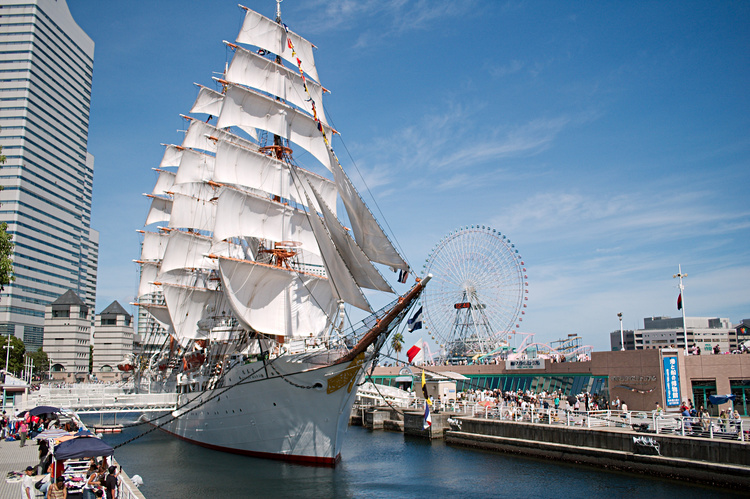
1 Yokohama Cosmo World. Across the water from Minato Mirai 21, is a small amusement park which boasts the Cosmo Clock 21, a 112.5-m Ferris wheel which doubles as "the world's largest clock" (the 60 arms double as second hands). The park also has two roller coasters, a log flume ride and several other attractions. Free but rides ¥500-700 each. Manyou Club. It is near the Yokohama Cosmo World in Minato Mirai 21. It is a spa resort. There are many kinds of baths to try while making the rounds. At night, you can see the lights of Yokohama from a foot bath on the roof. You can enjoy
城市概覽改寫自 Wikipedia,旅遊指南來自Wikivoyage (CC BY-SA)。照片來自 Wikimedia Commons.