
Mungo National Park
Australia · Oceania
關於Mungo National Park
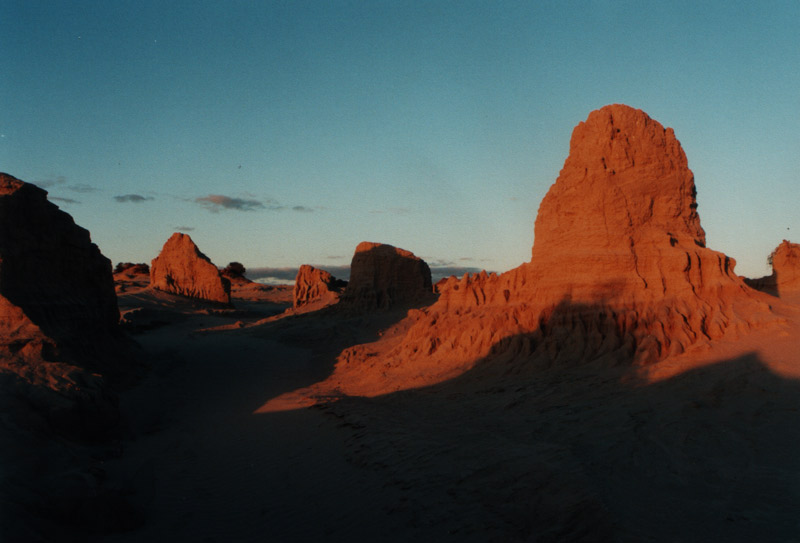
No other national park in the Outback is comparable to Mungo National Park — not even Uluru. The dunes of the Walls of China, archeological discoveries and fossil sites all make Mungo National Park unique. Located in the Lower Darling region of Outback in New South Wales, the park is part of the Willandra Lakes World Heritage Area, a mixed UNESCO site and one of only four in Australia. It's the site where some of the world's second oldest remains of modern human bodies outside Africa – Mungo Lady and Mungo Man – were discovered, making this place both naturally and culturally significant.
Lake Mungo is now just a dried-out salt lake that makes the soil alkaline, but it remained a freshwater lake until the last Ice Age. The current alkalinity of the soil has helped to preserve the unique formations, including the Walls of China, giving the park its extraordinary, impressive look.
Mungo National Park旅遊指南
城市概覽
The park is named after the lake that once occupied the region (which was named after St. Mungo from Glasgow, Scotland) but dried out after the last ice age. There are two main parts of the park you should know about.
The western side contains the visitor centre and most of the facilities. Apart from one campground, all accommodation is on this side. The eastern side is where you can find most of the views of the Walls of China. While they can somewhat be seen on the western side, the eastern side is a much better spot to see and photograph the walls because it is where the walls are located; hence, two of the three lookouts are on the eastern side.
History Evidence suggests that humans have lived in this region for at least 42,000 years; Mungo Man and Mungo Lady are at least 30,000–40,000 years old, making this area home to the world's second oldest modern human remains outside Africa (the oldest is in Laos). Because of this, the entire Willandra Lakes Region was made a UNESCO World Heritage Site on September 9, 1983. It was these remains that pushed back the time to when Indigenous Australians arrived from Southeast Asia from 45,000 to 65,000. Mungo Man was a well-respected Indigenous elder, and he was buried in ochre around the age of 50. Mungo Lady was only in her late teens. She was cremated, though the reason is unknown; she might have had some disease, but that theory is unproven and remains the world's oldest known cremated body. The park was acquired for the Australian National Reserve System in 1979 by the Foundation for National Parks and Wildlife, which raised the $101,000 required to purchase the property. The foundation also funded a resident archeologist to work on the site from 1979 to 1983. With funds donated by Dick Smith, the foundation established the Mungo Visitor Centre and Laboratory in 1983. With further sponsorship from BHP (an Australian mining company), the foundation implemented Mungo National Park's 70-km guided vehicle drive in 199
如何抵達
The first thing you need to understand is that Mungo National Park is far from all the big cities. The park is 1,000 km (620 mi) west of Sydney, 650 km (400 mi) north of Melbourne and 500 km (310 mi) east of Adelaide. For normal road trippers that are used to driving long distances on normal roads, remember that getting into Mungo also requires you to go on unpaved/unsealed roads. The park may close within a few days' notice, so check the alerts section of the park website before departing. Sometimes that can even be 24 hours.
By car Like most national parks in New South Wales, Mungo National Park can only be independently accessed by car. Finding tour guides to this park is not a walk in the park, so if you choose to not drive, you'll need to plan well ahead for a tour guide to take you. If you don't have a car but are willing to drive, the nearest rental cars can be found across the Victorian border in Mildura, a reasonably-sized city 110 km (68 mi) away. It's important to check that your rental car company allows you to drive on gravel roads as you will have to drive on a gravel road for most of your journey. From Mildura and Wentworth, the park often takes about two hours via Arumpo Rd, which is unsealed. The road can close at any time, particularly after rain which means you could be stuck for days – although it doesn't rain much in the area anyway and it is not a huge concern. There is another road via Balranald although the quality of the road surface is very poor with loose stones, and the route is longer at 147 km (91 mi). There's a third route via Euston, with very similar conditions as the road from Balranald, and is 120 km (75 mi). However, very few use this road and it is not well maintained as the other two.
By plane The closest airport with regularly-scheduled flights is Mildura Airport (MQL IATA), with regular flights by Regional Express (Rex) from Melbourne, Adelaide, and Broken Hill, and Qantas from Melbourne and Sydney. There are rental ca
當地交通
Much of the park is best explored by car, simply because the heat may tire you out and the distances are easily underestimated. There are good roads in this park, which despite being unsealed do the job just fine in getting you around places. On some maps, roads crossing Lake Mungo look as though you'll be driving through water, but rest assured – the lake dried up several thousand years ago. Getting around by mountain bike is also possible. There is one trail specifically for MTBs, but nearly all tracks in the park can cope with bikes. However, there's no rental shop in the park, so you will need to bring a bike with you. There are numerous walking trails in the park, suitable for different fitness levels. On the other hand don't ever think about walking the 70-km (43-mi) loop, which is only designed for drivers. Deviating off marked tracks and trails by car is not allowed in the park. However, there are no such restrictions when walking, and at times, this is the only way to get between places.
必看景點
Much of Mungo National Park's charm can be experienced via its lookouts, each a beauty in its own right. By far the most iconic feature of the park is the Walls of China, the last remains of the erosions of the dry Lake Mungo. You can spend hours just admiring their beauty, as each part of the Walls offers new and interesting views. These can be seen at a distance from various lookouts in the park, but the only way to see them up close is to go on a guided tour; see the "Do" section below. However, it'd be a shame to think the lookouts and the Walls were the only highlights of the park since the historic sites such as Mungo Woolshed and the Zanci Homestead are also significant.
Lookouts 1 Mungo lookout, Mungo Lookout Rd. Overlooking the vast dry bed of Lake Mungo, which was once home to kangaroos thrice the size of modern reds and carnivorous thunderbirds (Dromornis stirtoni) almost twice the height of emus, among other megafauna. You can also see some of the Walls of China from this lookout. . (updated Oct 2021)
2 Red Top lookout and boardwalk, Red Top Walking Track (along the self-guided driving tour, 30 min from the visitor centre). A quick short one hundred-metre walk (coloured in red on map) that is slightly elevated to best appreciate the beauty of the remarkable effects of erosion, And if you're thinking, "what's special about a simple 100-metre boardwalk", the answer to that is that it's one of the few places where you'll be walking slap bang right next to the Walls of China and the erosion of the lake.It's sometimes colloquially known as a photographer's secret spot, particularly during sunset or sunrise, where views particularly get more than what you expect. For those that don't know, Uluru only changes colours once every so often. The Walls of China, however, give a different light depending on sunlight. Sometimes orange, other times yellow, or even red at times.While you may encounter wildlife along this boardwalk, don't hope for it. It'
城市概覽改寫自 Wikipedia,旅遊指南來自Wikivoyage (CC BY-SA)。照片來自 Wikimedia Commons.