
Lower Glenelg National Park
Australia · Oceania
關於Lower Glenelg National Park
The South West Coast of Victoria, Australia is the area around the Great Ocean Road including the Surf Coast, and the Otway Ranges and the entire coastal region west to the border with South Australia.
The coastal regions of this area are typically broken up into the Surf Coast (Torquay to Cape Otway) and the Shipwreck Coast (Cape Otway to Warrnambool and beyond). These coastal regions contain the vast majority of tourism-related sites, while the inland towns are primarily working towns catering to the region's farmers and graziers.
It can more broadly cover Geelong and the Bellarine Peninsula, but Wikivoyage covers those two regions under Greater Geelong.
Lower Glenelg National Park旅遊指南
城市概覽
The first British settlement in Victoria was in Portland, in the far west of the South West Coast region, in 1834. Melbourne was founded only a year later. This area has become a major agricultural region in Victoria, with farms for dairy, beef cattle, lamb, and wool, as well as other crops. The only part of this region without significant farming activity is the Otway Ranges, which was once a major source of timber, but is now protected as Great Otway National Park, one of Victoria's largest and most diverse national parks, and a major tourist attraction. The Great Ocean Road, built by returned soldiers between 1919 and 1932, is a fantastic drive, not only for the scenery but also for the winding cliff-top roads. Before this road was constructed, the only access for towns on the rugged coastline was by sea. When the first section to Lorne was opened in 1922, road users had to pay a toll, which was abolished in 1936. Not only is the Great Ocean Road an attraction in itself, but it allows road access to virtually all of the region's major tourist drawcards. Its numerous twists, turns, and hairpin bends also make it great fun to drive, unless you're prone to carsickness.
如何抵達
Most visitors start from Melbourne, which is 95 km away from Torquay. Instead of Melbourne's main airport, fly into Avalon Airport near Geelong, which is much closer to the start of the road. There is car hire there, and it is regularly serviced by Jetstar. V/Line buses run from Geelong along the Great Ocean Road as far as Apollo Bay three times a day M-F and twice a day Sa-Su. On Friday a bus continues from Apollo Bay to Warrnambool. There are also daily V/Line trains to Warrnambool, but they travel inland.
當地交通
Having your own car gives you the most flexibility in getting around Coach tours are also readily available. There are many sights to see away from the townships, and along the coast. Getting to them by general public transport is difficult. There are so many pullouts and sights, that you can fall into a yet another spectacular vista fatigue, when driving the road. Is it worth pulling off the road for another cliff drop, another gorge, or another arch? Make sure you plan your trip, so you can skip some attractions if you need to, but don't miss the truly amazing ones.
Itineraries At its simplest, you won't need an itinerary, or even a map to drive the Great Ocean Road. Start at Geelong or Warrnambool and follow the signs. The eastern end of the route starts at Torquay, 22 km from Geelong. The sights are well signposted off the road, as well as nearby attractions. Information boards exist at all sights and attractions. The road is well developed for tourism, has regular information, food, fuel and accommodation. It's possible to drive the length of the road, and see the main attractions in a day's driving. Two days will allow you to see just about all of the coastal sights and towns, if that is what you want to do. Consider three days or longer if you want to stay longer at some towns, and do some walks, relaxation, or other recreation. If starting from Melbourne, remember that it's almost 100 km to the start of the Great Ocean Road at Torquay and another 264 km back from Warrnambool along the inland Princes Highway. This translates to a minimum of 600 km to get there, drive the road from end to end and come back, and doing this in one day doesn't leave much time for sightseeing — spending at least two-three days is a much better idea.
必看景點
Geelong — The largest city in the South West Coast Area, Geelong has bustling beaches and wonderful art. See the tallest building in the region, Worksafe Headquarters at 40 m. Visit the Botanical Gardens in East Geelong, with lots of green and get a glamorous view of the city. Also visit the construction sites of The Mercer and Miramar, apartment buildings set to be the tallest in Geelong at 80 and 90 m. The library has been nicknamed the Death Star by locals. Geelong has two major shopping centres: Westfield and Market Square, which have heaps of shops across two levels. Lara — Considered to be part of Geelong, it is a 15-minute drive from the CBD and has a train station. Lara is continuously growing, with new estates coming everywhere. You can also see the farm side of Lara and the 355-m You Yangs National Park. Torquay — A small town 20 minutes away from Geelong and on the Surf Coast Highway, Torquay has many things to see. Torquay is on the end of The Great Ocean Road, next to Jan Juc. There are the beaches full of people during summer, shops and more. Torquay also has the Australian National Surfing Museum. Torquay is still growing, with a plan to be part of Geelong in the future. Bells Beach — Surfing mecca - crashing waves, lots of surfers and kangaroos in nearby grasslands in the early morning Point Addis Surfing, and an indigenous walk through the bushland to a lookout over the beach. Signs provide insights into how the local Aboriginal people used the land (approx 30 minutes return). Split Point — Aireys Inlet. Angahook-Lorne State Park. The park has many walking trails particularly in the Aireys Inlet and Lorne areas. Teddy’s Lookout, Lorne — Provides a view of the Great Ocean Road as it winds along the coastline. Wye River and Kennett River villages for koala sightings, Wye River — Both small villages have excellent koala populations in trees easy for visitors to see. Marriner’s Lookout in Apollo Bay — Views of the township and the 3 bays that make up
體驗活動
Walk. Many of the natural features have surrounding walks, but there are developed paths for longer walks.
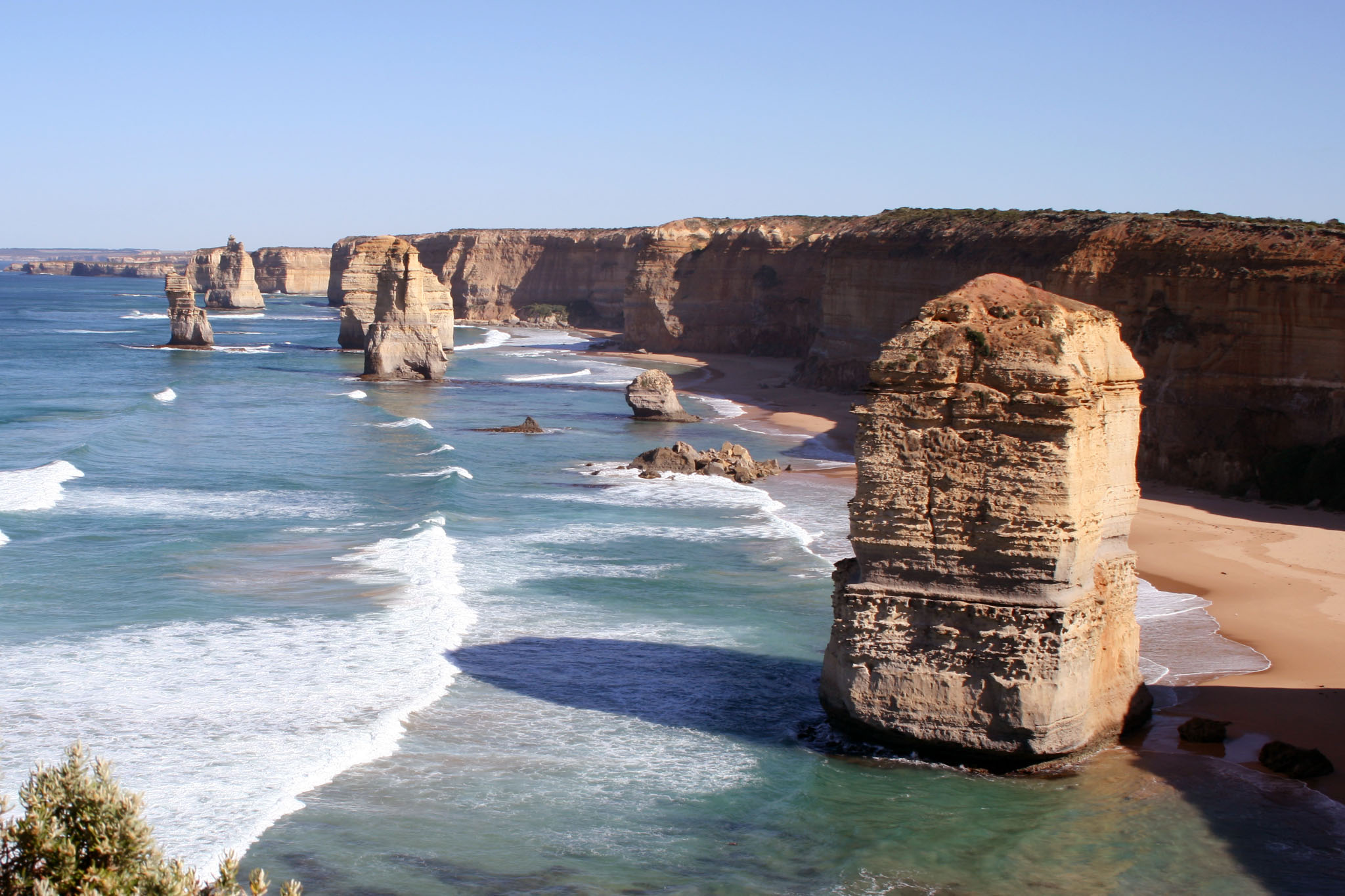
Great Ocean Road. It's more than a road – it represents a coastal region of south-west Victoria, running from Bellarine Peninsula near Geelong to Portland near the border with South Australia. The Great Ocean Road was built as a work project for veterans returning from World War I and was completed in 1932. The core of the Great Ocean Road, highway B100 from Torquay to Allansford near Warrnambool, runs for 243 kilometres. One of the most scenic parts of the road is the stretch between Port Campbell and Peterborough. This is the section contained by Port Campbell National Park and has the major rock formations. Surf Coast Walk. Coastal walkway of 30 km from Jan Juc Beach near Torquay through Bells Beach, Pt Addis, Anglesea and Aireys Inlet to Moggs Creek in the Angahook-Lorne State Park. The total distance takes about 11 hours but there are many access points so it can be done in sections. Lake Elizabeth, Forrest. Enjoy the beauty of the rainforest in this easy walk or take a canoe tour at dawn or dusk to visit the elusive platypus in its natural habitat. A place to see the famous and elusive 100-million-year-old egg-laying mammal. Otway Fly Tree Top Adventures. Walk through the treetops on the 25-metre-high elevated tree-top walk. This sky walk takes you through a magnificent stand of cool temperate rainforest featuring Myrtle Beech, Blackwood and Mountain Ash. A spiral stairway takes yo
城市概覽改寫自 Wikipedia,旅遊指南來自Wikivoyage (CC BY-SA)。照片來自 Wikimedia Commons.