
Kutimpu
Peru · Americas
關於Kutimpu
Puno is a port city at an altitude of over 3,800 meters, on the shores of Lake Titicaca on the Altiplano of Peru - though because it's located within an enclosed bay, you won't see the full scale of the lake here unless visiting the outlying islands of Taquile and Amantaní.
In 2018, Puno had about 129,000 residents. Though it does have a fairly cute historic center, its biggest attraction for tourists is as a departure point for the famous Uros floating islands on the Peruvian side of Lake Titicaca. This, and its proximity to the Bolivian border, means that it’s a regular stop on the South American tourist trail.
Kutimpu旅遊指南
城市概覽
Its full name is San Carlos de Puno, and it was founded on November 4, 1668. Puno is also the name of the region. Puno, over the years, has grown from a village to a city. Today, it is a dynamic center for administrative activities. In the not so distant past, its remoteness meant that it was a destination for punishment transfers for those in the military and government (i.e if you screwed up, you would get transferred to Puno). The oldest urban center in the area, called Pucará, was established in the Puno region, boasting monumental architecture, sculpture, and valuable pottery. It was there that the domestication of high Andean plants and animals happened, and what would become the Tiahuanaco civilization was forged. The city of Puno is a melting pot of the Aymara and Quechua cultures. Most of its inhabitants are of Andean origin and it has a unique mixture of modernity and Andean traditions. Women in traditional clothing live and work next to their modern versions. Puno is not exactly the jewel of Peru, but it has its charms. The central square is reasonably pleasant. Calle Lima is a pedestrian walking street with most of the restaurants, bars and clubs. The main reason to visit Puno is to get out onto Lake Titicaca. Almost every hotel will offer some kind of packaged boating deal for the lake, and most of them are good. There is a lot of competition (and good business deals) between the hotels and the tour boats, so most of the prices stay fairly even. If you feel your hotel is making a reasonable offer, take it – a van will be able to pick you up right at the hotel door.
Climate Puno's elevation is about 3,822 m, which means it is cold at night, and it is very high, so there is significant risk of altitude sickness (80% if you go directly from sea level). If you arrive from a lower elevation, it is safer to spend a few days acclimatizing at a lower altitude before Puno, and then a day or two taking it easy in order to acclimatize. A gradual ascent might st
如何抵達
By train
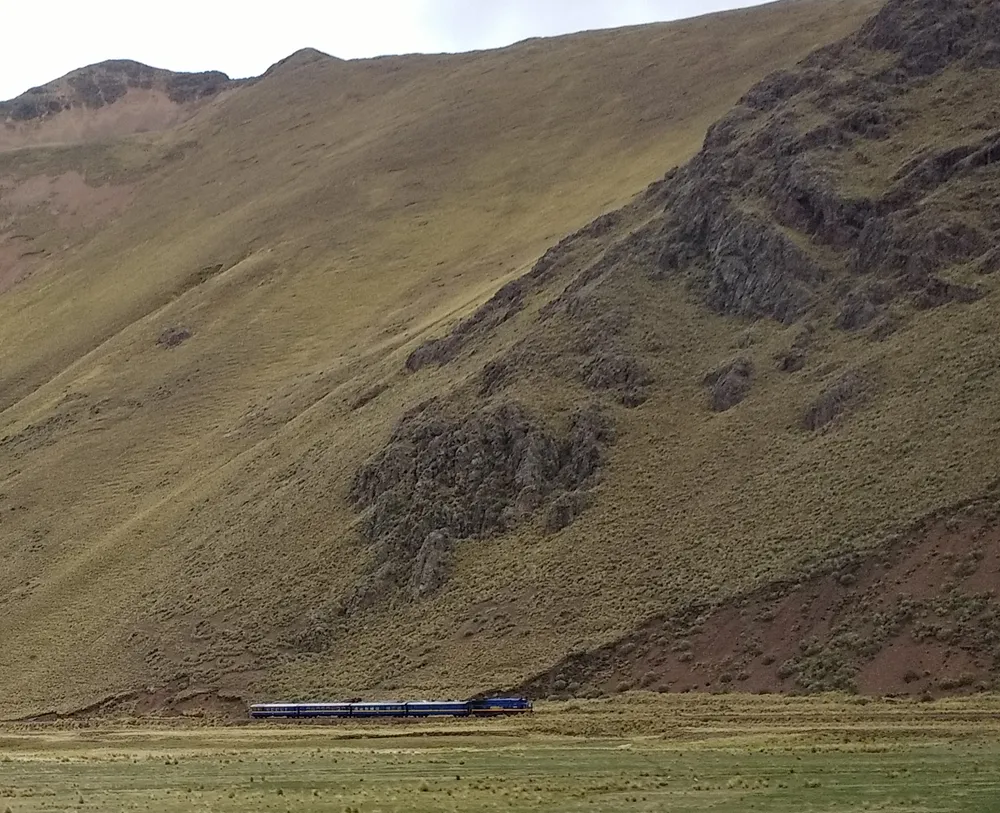
Trains to and from Cusco travel three times per week. The “Andean Explorer”, run jointly by Peru Rail and Orient Express, is spectacular — one of the world’s great train journeys. It leaves Cusco W F Sa at 07:10 and arrives at Puno at 17:30 (US$313-334 one way as of Dec 2017). The other way (leaving Puno M Th Sa at 07:30, arriving at Cusco at 17:50) is significantly cheaper: US$186-196 (Dec 2017). Don’t look for the backpacker class for less money, it is not running anymore. The trip takes in Andean mountains and valleys of the Huatanay River, before reaching the Andean Plains, La Raya (the highest point of the route) and finally Cusco. The train stops at La Raya for about 10 min to allow passengers to get off. There are stalls selling local handicrafts, e.g. alpaca sweaters, rugs, chess sets. Ensure that you bargain hard. Without a doubt, it is the best way of travelling to or from Cusco and Machu Picchu. The train to Arequipa is only used for goods and no longer for passengers.
By bus The 1 Terminal Terrestre is about a 20-minute walk (or a much faster taxi ride) from the Plaza de Armas. Daily buses depart to and from Cusco, Arequipa, Copacabana, Lima, and La Paz. Buses depart to Copacabana twice daily. There are 4 buses that depart at 07:30 (S/15 (soles)) but only Titicaca has an afternoon service that leaves at 14:00 (S/20). There is a departure fee (tasa de embarque) for passengers on buses leaving from the terminal (S/1.50 as of 2017). Pay it at a little office in the middle of the terminal, where the clerk will put a sticker on your ticket to show that you've paid. Ormeños has buses leaving Puno between 08:00 and 09:00 every day. The departure time depends on how long the bus takes to arrive from Lima, so it is necessary to call Ormeños in Puno or Arequipa at about 07;00 to find out what time the bus will be passing through. The price is S/100 per person and the journey should take about 6 hours.
From Cusco There are three types of buses
當地交通
Many of the hostels are set on a hill above the Plaza del Armas which feels even steeper because of the altitude.
Taxis or motor-rickshaws will not charge you more than S/3 (taxi) or S/2 (moto) for a ride within the city. Urban colectivos charge S/0.50.
必看景點
Most Puno sights are outside of the city. Check the “Go next”-section below.
1 Cutimbo. Vans depart from Puno as soon as they fill up, usually every 20-30 minutes. A tiny settlement some 30 km from Puno, in the Peruvian Altiplano, mostly visited on a short daytrip. Although the ruins at Sillustani are greater in most aspects, they also get loads of visitors. You can walk up the hill (about 30 minutes) for the ruins and amazing views of the surroundings and stop by the rather modest cave paintings on your way up. S/2.5 for the van. Entry fee S/15 - adult, S/5 - student, S/2. - children. (updated Nov 2018) Uros Floating Islands. Tour boats leave every 40 min from the dock (S/5 by taxi). These cost S/10 for the return boat trip plus a S/10 entry fee to the islands. The last boat leaves around 16:30. The boat takes you to a couple of different islands (there are more than 50) where the island’s “president” explains how the islands are built. Everything is made of reeds, including the islands themselves, and some of the houses and boats. Notoriously commercialized (including hidden fees), but also a genuine wonder, and you can sidestep some of the schlock by independently booking overnight lodging in the islands. (updated Aug 2025) The Islands of Taquile and Amantani where you can sleep over with a local family. The peninsulas of Chucuito and Capachica that form the right and left arm of the Puno Bay. In Chucuito you can stay in Luquina Chico or Karina, in Capachica the community of Llachón is becoming famous, but you can also stay on the other side of the peninsula in Ccotos or the small island of Tikonata. In Puno you can visit the panoramic viewpoints of the Puma and the Condor statues, but especially the last one has had security issues the last few years. Visit in group or accompanied by locals. Especially the Condor has a great view on the bay. Take a taxi (S/8) to the top and go down the more than hundred stairs, in 10 min you are on the main square. Also worth
體驗活動
Kayaking with Augusto. Augusto is really into kayaking and an experienced guide. He cares very much for the well-being of the participants and does everything to make everyone feel safe and comfortable. He offers a tour to the Reserva Titicaca Lake (3 hours/US$35 per person) and to the floating islands Uros (5 hours). He was born in Peru and lived many years in the United States, so he speaks Spanish and English very well. There are several llama farms in Puno available for tourists to go to. You can learn about the history and agricultural llama use. Fun Fun!, check all the places in Inca lake
購物
You can buy souvenirs here for less than in Cusco or Lima. There is a fairly large market down by the water.
美食
Budget If you get away from the hea
城市概覽改寫自 Wikipedia,旅遊指南來自Wikivoyage (CC BY-SA)。照片來自 Wikimedia Commons.