
Kaza
India · Asia
關於Kaza
Kaza is in the Trans-Himalayan region of India at an elevation of 3,800 metres (12,500 ft) above average sea level, Kaza is the biggest and most developed town in the Spiti Valley of Eastern Himachal Pradesh.
Kaza旅遊指南
如何抵達
Kaza is the district headquarters of Spiti district in Himachal Pradesh. There are two ways to get to Kaza: From Manali Only open from May (when the snow clears) until October 15th. This route used to go over the Rohtang Pass but now avoids it thanks to the Atal Tunnel. As of 2024, you can take a shared 'taxi' (9 hours, ~1500rs/person), a shared van (10 hours, ~1200rs/person), or a public Himalayan Road Transport Company (HRTC) bus (leaves once per day, 12 hours, ~450rs). The road surfaces are very poor; the entire stretch has never been metalled/tarred. The ride is generally very bumpy, dusty, and somewhat dangerous due to the cliffsides. But on asking a local person about the road quality, they'd say that the road is a "good road". You will have to cross about a score of streams flowing across this State Highway No. 30 which could be about a couple of feet deep. Several locals reported in 2024 that the road was being tarred in the coming years. From Shimla The road from Shimla (via Rekong Peo) is in theory an all-season one. HRTC buses link Kaza with Manali and Rekong Peo. The Rekong Peo connection passes through landslide area at Malling Nullah, with transshipment (crossing on foot and being picked up by a bus on another side) being frequently the only way of passing the landslide. Many people will hire shared taxis or book with a tour group that stops in various towns like Shimla, Sangla, Kalpa, and Nako along the way.
當地交通
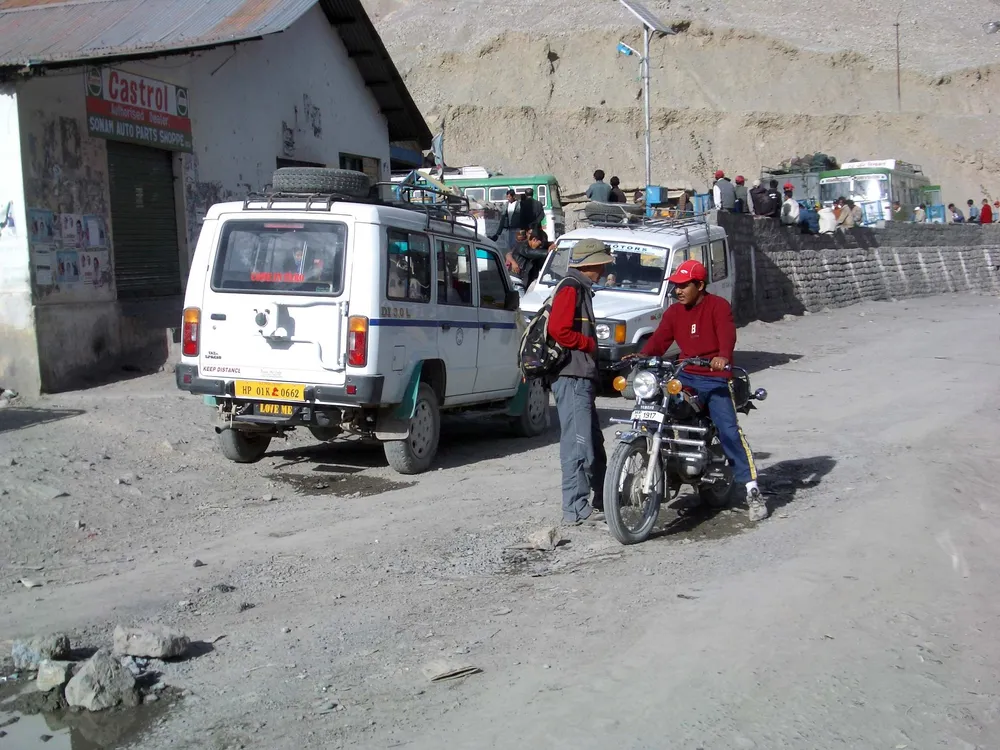
The town itself is small and can be walked from one end to another in 30 minutes. To visit local sights (e.g. Key Monastery, Hikkim Village, etc), you can schedule a shared taxi through your accommodation or through the taxi stand. Cost is ~2500rs total (in 2024). The taxi stand has jeeps for hire for fixed rates (listed at the booth). In summer, state transport runs buses through both routes (i.e. Manali-Atal Tunnel-Kaza, and Shimla-Reckongpeo-Sumdo-Kaza). In winters, only one bus runs between Reckongpeo and Kaza each way, both of them leaving early in the morning. Roads are dangerous to drive so if you don't have experience of driving on Himalyan roads, don't do it. In winters there are no buses to villages, so the only option is to hire a taxi, which is not cheap: every km may cost you ₹25-₹40 or more, though it is cheaper than tourist season of summers. It is common for people to hitchhike in this mountain terrain, where the locals are extremely friendly and willing to help. It is also possible to arrange for a trek, jeep safari, yak safari or mountain biking via the office of Ecosphere, which conducts responsible and volunteer travel trips and tours in the region ([email protected]). Bus schedule (in 2020)
To Manali : 6:30AM Tabo: 7M and 3PM Pin Valley: 4PM Kibber/Ki monastery: 5PM
必看景點
Key Monastery: This is about 20 km from Kaza. Every visitor is greeted by a complimentary tea. The monks might give a guided tour also. Photography is not allowed inside the prayer rooms but is allowed in the outdoor areas. Komik village: It is at a height of 4275m. It has a small monastery (women are not allowed inside during prayers). Fossils are also found in this region. The villagers might try to sell the fossils but it's probably not legally allowed to buy and transport the fossils. Hikkim village: A few kilometres before Komik. Main interest is the "world's highest postoffice", so it could be a good place to post your postcards Kibber village: Frequently, and wrongly claimed by the locals as the highest village in the region. Sakya Kaza Monastery: A monastery which was inaugurated on July 9th, 2009 by His Holiness The Dalai Lama. Dhankar monasteries: Dhankar is about 40 km from Kaza in the direction of Peo. You can get there either by a taxi, which will take you all the way up the mountain to the monastery, or by the Himachal Pradesh Road Transport bus (leave at 7AM, return at 3PM from Shichling). The bus will drop you at the junction between Dhankar and Shichling villages. From the Shichling fork, you need to trek nearly 10 km to get to the monastery by motorable road or by one of the numerous steep mountain trails. There are two gompas at Dhankar village, the much-famed, 1000 year old monastery hidden in the Spitian mountain rocks and the new Gompa, inaugurated by the Dalai Lama. The old monastery is literally tethering on the edge and the 60 monks who live in the Gompa are being relocated to the new Gompa until the restoration and reinforcement of the older Gompa is complete. Do visit both the Gomaps if you get a chance. The lamas at the older monastery are very helpful and the inquisitive little Dhankar boys (studying to become lamas) will invariably be more than happy to show you around. If you have a chance to meet the head lama at Dhankar, make sure yo
體驗活動
There are a host of outdoor activities that can be done in the areas surrounding Kaza. Most of these can be arranged beforehand through a tour group, or at your accommodation when you arrive.
Mountain biking Trekking Day hikes: outside of walking down the road or doing a multi-day trek, there are few day hikes near Kaza itself. There's a steep day hike near the Buddha Statue near the highway (on Google Maps as "Buddha statue Kaza top"). Camping generally takes place at Chandra Taal, a high-altitude lake that's 3-4 hours from Kaza
購物
Seabuckthorn tea and juice (seabuckthorn is a local high-altitude berry that's said to provide a variety of health benefits) Various Tibetan-style goods (rugs, bracelets, trinkets, singing bowls, etc) Fresh local produce, depending on the season (apples, peas)
美食
There are many restaurants in town open during the summer tourist season. Most offer Himalayan and Indian food. Some restaurants offer Israeli, Mexican, Italian, and other Western-style foods. Chicken and mutton dishes are commonly available. Popular local foods include:
Thukpa, Thenthuk, and Skew/Kyue: various types of noodle soups with steamed vegetables Momos (dumplings) with vegetable, chicken, or mutton fillings Tibetan bread or roti. Unlike the usual rotis in India, which are made from wheat flour, Spitian rotis are made from barley or other millet flours and some baking powder is added to the dough while it is roasted on a hot pan. It is very soft and fluffy in texture and a well-made "roti" can puff fully like a ball while on the pan. It is eaten with butter, jam or an omelette. The most popular beverage is boiling-hot, overly sweetened lemon tea made without milk, which is quite good after sunset, once the chill sets in. Popular well-reputed (if a bit pricy) restaurants include Cafe Piti, Himalayan Cafe, and Hotel Deyzor.
飲品與夜生活
In an attempt to encourage responsible travel and conservation in the region, an organization called Ecosphere has set up an office shop near the Kaza market, where you can refill clean and safe drinking water, instead of buying multiple plastic mineral water bottles. Here you can also buy seabuckthorne juice and concentrate. Grown in Spiti valley, seabuckthorne is a "magical" berry with a
城市概覽改寫自 Wikipedia,旅遊指南來自Wikivoyage (CC BY-SA)。照片來自 Wikimedia Commons.