
Kamphaeng Phet
Thailand · Asia
關於Kamphaeng Phet
Kamphaeng Phet (กำแพงเพชร) is a city in Lower Northern Thailand with around 30,000 citizens. Its historical park with ruins of 14th- to 16th-century temples, city fortifications and Buddha statues is part of the UNESCO World Heritage site "Historic Town of Sukhothai and Associated Historic Towns".
Kamphaeng Phet旅遊指南
城市概覽
In the lower north of Thailand on the bank of the Ping River, Kamphaeng Phet is about halfway between Bangkok and Chiang Mai. To its east are riverine plains while the western areas are made up of high mountains lush with forests where a number of national parks have been established. Areas along the river bank at present-day city used to host several ancient towns which played a major role as strategic front-lines since Sukhothai was the kingdom's capital down through the times of Ayutthaya and early-Rattanakosin (Bangkok) eras. The name Kamphaeng Phet actually means "wall as hard as diamonds". Kamphaeng Phet declined in importance and was an ordinary, smallish provincial city until the establishment of the historical park and its listing as a World Heritage site in 1991. Still, unlike its well-known neighbour Sukhothai, Kamphaeng Phet is largely ignored by tourists. This is why the city has barely any offerings geared to the needs of international travelers. Some may view this as a drawback, but those looking to experience authentic, upcountry Thailand, are coming just to the right place. Kamphaeng Phet is a "banana capital". Its local speciality are "egg bananas" (kluai khai in Thai), whose fruit are only about 10 centimetres (4 inches) long, almost oval shaped (hence the name) and much more aromatic then the run-of-the-mill long, bent banana varieties sold in most non-tropical countries. Kamphaneng Phet Province exports bananas worth 200 million baht each year.
如何抵達
By plane The closest international airports are Bangkok-Suvarnabhumi (BKK IATA) and Don Mueang (DMK IATA), 370 and 340 km from Kamphaeng Phet, respectively. Flying to the regional airports of Phitsanulok or Sukhothai only makes sense if you are picked up or rent a car there, as public transportation from these airports to Kamphaeng Phet is inconvenient and very slow.
By train Kamphaeng Phet is not connected with the rail network. The closest train station is in Phitsanulok, from which it's a nearly three-hour bus ride to Kamphaeng Phet.
By bus The most usual way to get in, is by bus. Buses from Bangkok's northern terminal (Mo Chit) and from Chiang Mai arrive about hourly. There are also some overnight connections. The ride from Bangkok takes five to six hours and costs 204 or 263 baht, depending on the class of coach. Most buses from Bangkok to Chiang Mai, Uttaradit, Mae Sot, Sawankhalok or Sukhothai stop in Kamphaeng Phet and may be used (ask at the counter). Non-AC regional buses from Phitsanulok run hourly, from 05:00 to 18:00. The 100 km takes nearly three hours due to frequent stops and detours to villages along the way. A ticket costs 59 baht. From Sukhothai you may either get on a bus towards Bangkok and hop off at Kamphaeng Phet, which takes some 1½ hours and costs around 70 baht (though passengers who book all the way to Bangkok may be preferred) or take the more rustic songthaew (converted pickup with passenger benches on the bed) that departs whenever there are enough passengers, takes up to 2½ hours and costs 60 baht. The government-owned Transport Company's 1 bus terminal used by most intercity buses is somewhat inconveniently located, about 2 km outside the city centre, on the other bank of Ping River. From there, irregularly running songthaews, tuk-tuks, or motorcycle taxis (if available) take you to the city centre. Preferably, you ask your hosts to arrange a pickup.
By car Kamphaeng Phet is conveniently accessible via Route 1 (Asian Highw
當地交通
Kamphaeng Phet lacks an actual public transportation system. The city is not well prepared for tourists. There are no regular taxis, and even tuk-tuks, motorcycle taxis, or rickshaws are pretty rare. Reddish-brown painted songthaews (i.e. converted pickups with benches on the bed) cruise through the city, between the bus terminal and Big C shopping mall. Their departure times are irregular. Other songthaew lines connect with the surrounding province, departing either from the bus terminal or the large day market in the city centre. It may be difficult to find out where exactly they are going without speaking Thai. They do not have exact departure times either, but go whenever there are enough passengers for a certain destination. To be independent and be able to do individual excursions to the hinterland, it is best to arrive with a hired car (e.g. from Phitsanulok) or to rent a motorbike (e.g. at Three J Guesthouse or Praepimpalai Resort). Most distances within the city centre can be covered on foot. Moreover, Kamphaeng Phet is relatively bicycle-friendly (at least, in comparison to most Thai cities). While there are no designated bike paths, traffic on the roads is quite minimal, and there are quite a lot of green areas. To discover the historical park, the bicycle is just about the ideal means of transportation: it is a little too far to walk, while you cannot see that much from inside a car. Some guesthouses lend or rent out bikes to their guests. Another rental location is right at the entry to the historical park (Khet Aranyik)—30 baht per hour, mountain bikes for 50 baht.
必看景點
Historical Park
Kamphaeng Phet's Historical Park of temple ruins, Buddha statues, old walls and forts from the 14th to 16th centuries is part of the UNESCO World Heritage and the town's main sight. It consists of three separate parts. Admission to either the "inner district" or Khet Aranyik costs 100 baht each. A combined ticket for both sections is 150 baht. The walls, forts and the sights of Nakhon Chum can be accessed without a ticket. The zones that are surrounded by fences are open daily 08:00-18:00.
1 Khet Nai (Inner district). The ruins of the temple district of the ancient city of Cha Kang Rao, including Wat Phra Kaeo and Wat Phra That. The Reclining Buddha of Wat Phra Kaeo is arguably the most beautiful statue in the park and one of the best depictions of the Buddha's serene smile from the Sukhothai period. The zone is surrounded by five metre high laterite walls and a 25-metre wide moat. Four of ten forts and gates are relatively well-preserved and can be visited. (updated Mar 2017)
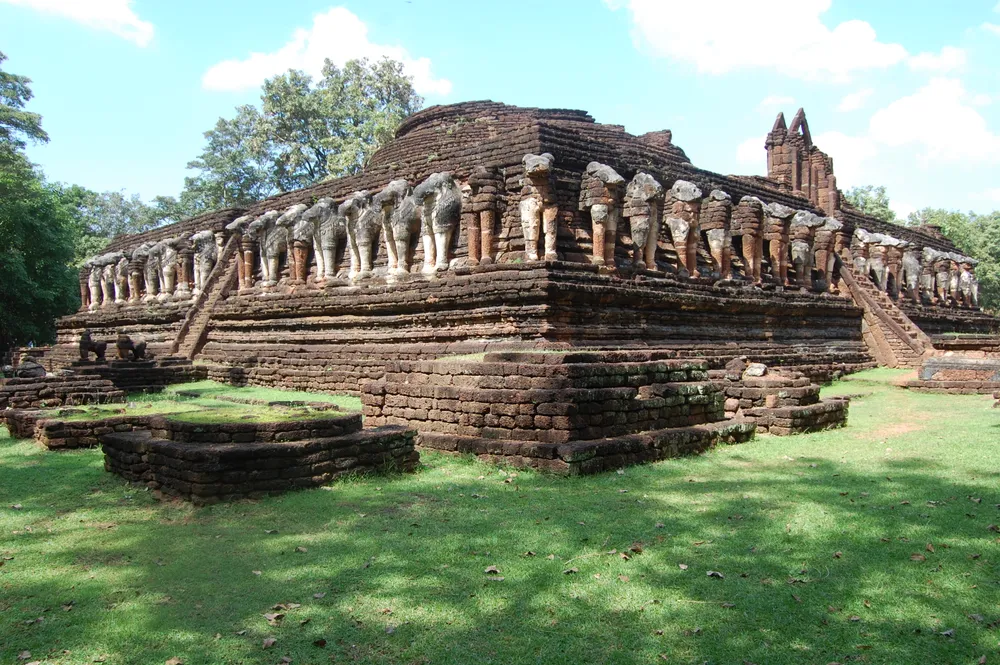
2 Khet Aranyik (Forest district). Thailand's Buddhist clergy was divided into "town monks" who studied, taught and performed ceremonies for the believers, and "forest monks" who went into retreat, dedicated to meditation and asceticism. The bigger part of the historical park, covered with light forest, consists of the hermitage ruins of the latter group. Thanks to the canopy of leaves, it is very pleasant to visit on foot or by bicycle (can be rented by the main entrance). Its main sites are Wat Chang Rop (with its remarkable chedi that is surrounded by 68 stucco elephant figures), Wat Phra Non (with a relatively well-preserved chedi and remains of a Reclining Buddha statue), Wat Phra Si Iriyabot (with the park's only surviving, nine metre high standing Buddha statue). Next to the main entrance to this zone is also the park administration. (updated Mar 2017) 3 Mueang Nakhon Chum.
城市概覽改寫自 Wikipedia,旅遊指南來自Wikivoyage (CC BY-SA)。照片來自 Wikimedia Commons.