
Historic Churches of Buffalo's East Side
United States · Americas
關於Historic Churches of Buffalo's East Side
The United States has always been a nation of immigrants, but at no time in its history was that more true than in the 19th century, when millions upon millions of folks hailing from all over Europe—"the tired, the poor, the huddled masses", in the famous words of Emma Lazarus—sailed across the ocean in search of a better life.
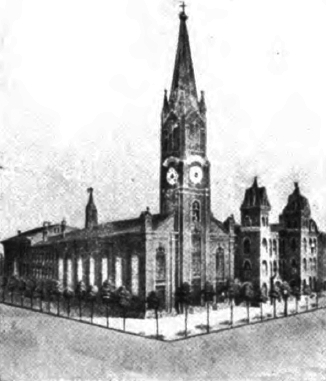
With plenty of easily available jobs in factories, on the railroads, and at the harbor, Buffalo was a major destination for these newcomers—and the East Side of the city was one of its most vibrant immigrant neighborhoods. The East Side was home to a patchwork of different nationalities, but above all folks from Germany and Poland. In many ways, the East Side of those days bore more resemblance to Europe than the rest of the United States: traditional food, music and culture were everywhere, English was oftentimes relegated to second-language status, and the same as in the old country, the tallest and most magnificent building in any given neighborhood was invariably the parish church. These were palatial buildings the equal of any in their parishioners' native lands, towering symbols of the pride and prosperity they had sought and finally achieved in their new home.
The descendants of these immigrants have almost all left the old neighborhoods, but many of their churches live on as the East Side's contribution to the rich architectural cornucopia Buff
Historic Churches of Buffalo's East Side旅遊指南
城市概覽
The 1840s was a time of intermittent warfare, political turmoil, and religious persecution in the region now known as Germany, and the chaos drove many Germans to seek refuge in other lands. The flat, fertile plains east of what is today downtown Buffalo soon became home to a bustling German Village. Unlike most immigrants of the day, most of Buffalo's Germans were well-off and skilled in a variety of trades, and the neighborhood soon prospered. The East Side grew steadily outward from downtown, with the most rapid period of growth taking place from 1860 to 1900. The scheme hit on by real estate speculators to attract development to new land was an ingenious one: upon dividing it up, the owner of a tract would donate one of his choicest lots free of charge to the Catholic Diocese or some other religious group for the construction of a church, which would act as a magnet to attract homebuyers. In this way, developers could even exercise a measure of control over the ethnic and religious makeup of the new neighborhood—this was essentially what Joseph Bork did with St. Stanislaus, as you'll read later. For most of the second half of the 19th century, Germans made up more than half of Buffalo's population and a large proportion of the city's business and political elite—for a time there were even calls for the city government to make German a co-official language alongside English. Beginning about 1870, the Germans were joined by a large Polish community centered around the corner of Fillmore Avenue and Broadway, which made up an additional 10% of the city's population by the turn of the century. Also present on the East Side in smaller numbers were Jews, Italians, Russians, Hungarians, Ukrainians, and—later on—African-Americans. It was the rapid growth of the black community beginning around the First World War—along with a healthy dose of racial prejudice—that drove whites away from the East Side toward the suburbs as the 20th century wore on. More and more during tha
如何抵達
The tour begins and ends at the corner of Broadway and Michigan Avenue. To get there from downtown, head to Lafayette Square then continue eastward for four blocks on Clinton Street (which begins on the south side of the square, in front of the Hotel Lafayette). At Michigan Avenue, turn left and proceed for two blocks. To get there from the suburbs, take the Kensington Expressway (NY 33) for 6.5 miles (10.4 km) past the New York State Thruway and get off at the Goodell Street exit. Michigan Avenue will be your first left; turn there and proceed for four blocks. At 20.5 miles (32.9 km) in total length, the Historic Churches of Buffalo's East Side itinerary is not really suitable for any mode of transportation other than private car. Distances between the churches are far too long to cover on foot, and while the East Side is the part of Buffalo that's best-served by public transit, the extent of the network and frequency of service is not quite enough to make the bus a viable alternative to use on this tour. Particularly avid bicyclists might be able to pull it off, but they should know that dedicated bike lanes and other infrastructural elements for cyclists are few and far between on the East Side.
順遊推薦
If the East Side's roster of magnificent old churches wasn't enough for you, then you'll be happy to know that there are many more to admire all over the area.
Just beyond Buffalo's southern border is Lackawanna, a working-class industrial city that's the somewhat unlikely location of the most magnificent church in the entire Buffalo area, Our Lady of Victory Basilica. A Baroque Revival masterpiece completed in 1926 to a design by Emile Ulrich, it stands today as a testament to the charitable works of Father Nelson Baker, who as of this writing is being considered for sainthood by the Holy See. Downtown also has quite a few magnificent churches, including St. Joseph's Cathedral on Franklin Street that serves as the seat of the Catholic Diocese of Buffalo, as well as St. Paul's Episcopal Cathedral, a National Historic Landmark that's one of the best-known designs of Richard Upjohn—the architect whose magnificent body of work, more than anyone else's, popularized the Gothic Revival style in the United States. Aside from being home to many of the Germans and (especially) Poles that fled the East Side in the middle 20th century, Cheektowaga is also where you'll find the Maria Hilf Chapel, a local pilgrimage site established in 1853 by Alsatian immigrant Joseph Batt as a tribute to Our Lady Help of Christians, whom he credited for his family's survival after the ship they were taking to America found itself caught in a hurricane.
城市概覽改寫自 Wikipedia,旅遊指南來自Wikivoyage (CC BY-SA)。照片來自 Wikimedia Commons.