
Great Wall of China
People's Republic of China · Asia
關於Great Wall of China
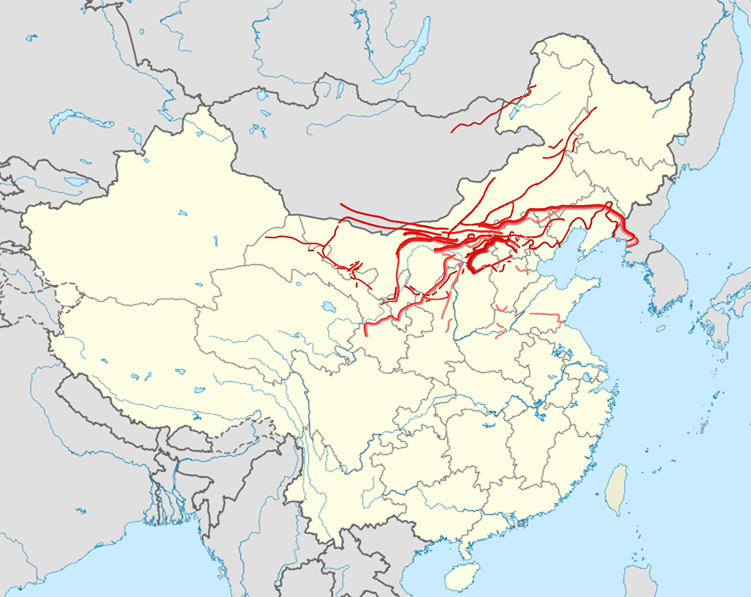
The Great Wall of China (万里长城 wàn lǐ cháng chéng) is a series of walls that stretch from Liaoning through Hebei, Tianjin, Beijing, Inner Mongolia, Shanxi, Shaanxi, and Ningxia into Gansu within the country of China.
Great Wall of China旅遊指南
城市概覽
The Great Wall of China can be visited at many places along its length of several thousand kilometers. Its condition ranges from excellent to ruined, and access varies from straightforward to quite difficult. Different sections also each have their own admission fees, e.g. if you want to hike from Jinshanling to Simatai then you probably have to pay twice. Although its construction is popularly associated with the tyrannical reign of the first emperor, Qin Shi Huang Di in the 2nd century BC, the wall that tourists see today dates much later to the Ming Dynasty.
History The Great Wall, as we know it, is actually a series of several walls built at different times by different emperors.
First Great Great Wall: built by the Qin Dynasty 221–207 BC Second Great Wall: built by the Han Dynasty 205–127 BC Third Great Wall: built by the Jin Dynasty 1200 AD Fourth Great Wall: built by the Ming Dynasty 1367–1644 The other walls are now mostly ruins. It is the Ming wall that turns up in all the photos.
First Great Wall
The First Great Wall was ordered built in 214 BC by Qin Shi Huang Di after he had finished consolidating his rule and creating a unified China for the first time. The wall was designed to stop raids by the nomadic Xiongnu raiders from the north. 500,000 laborers were used during the 32-year building period to create the First Great Wall. Although the wall worked at keeping out enemies, it did nothing to stop internal pressures which lead to a regime change in 206 BC and the new leadership of the Han Dynasty. The first Han emperor, Gaozu, was quick to see the benefits of the wall against the raiders and ordered more wall to stretch out as far as Zhaoxiang, Gansu Province.
Second Great Wall Over 70 years later, the Han Dynasty were still fighting the raiders since the Great Wall had been left to deteriorate and the raiders had breached it in several places. In 130 BC, Emperor Wu of the Han Dynasty embarked on a program of extending, rebuilding and fortify
如何抵達
See local articles for detailed transportation on getting to specific sections of the Great Wall. Rural Beijing, Yanqing District and Northern Suburbs has details on getting to sections in north Beijing.
必看景點
As the Great Wall of China is rather on the long side, there are a large number of places to visit it. The following list is divided by province/municipality.
Beijing Find more detailed descriptions for each individual section in Northeastern Beijing, Yanqing District, Huairou District and Northern Suburbs.
Badaling (八达岭 Bādálǐng) - The most popular tourist section in Beijing. It is well restored and super crowded. It takes ~2-3h to hike the whole wall depending on your fitness/weather/crowd. Shuiguan (水关 Shuǐguān) - Located near the Badaling Great Wall, Shuiguan is sometimes referred together as the 'Badaling-Shuiguan Great Wall'. It often happens that visitors are guided to the Shuiguan Great Wall rather than Badaling especially during holidays or peak periods. Juyongguan - Nearest section to the center of Beijing. Quite popular among tourists but nowhere near as crowded as Beijing. An expressway cuts through the section which does dampen the view. Mutianyu (慕田峪 Mùtiányù) - Magnificent and as equally well restored as Badaling. In comparison it is significantly less crowded than Badaling and has greener surroundings. Huanghuacheng (黄花城 Huánghuāchéng) - One of the most well built sections of the Great Wall - in fact it was so painstakingly built that the builder, Lord Cai, was beheaded for mismanagement and waste. This section is notable for its picturesque lakeside location. Simatai (司马台 Sīmǎtái) - Far off from central Beijing and in combination with the adjacent Gubei Watertown, a reconstructed historical town, has become a popular weekend travel destination for domestic and international tourists. Night tours overlooking the well illuminated Gubei Watertown are popular and tickets are sold separately. Gubeikou (古北口 Gǔběikǒu) - Also far from central Beijing than other sections but the extra time it takes to get there is rewarded with a very significant reduction in crowding and tourist traps. Jiankou - A section filled with landmarks and many pictures of the
體驗活動
Hike the wild wall. Make seeing the Great Wall a personal experience by hiking an unrestored or wild section where tranquility and isolation can be found. Popular hiking routes in Beijing can be found in the Do section at Rural Beijing. (updated Sep 2019)
住宿
If you want to go on a multi-day trek over a wild section or just see the sunset, you can sleep in the towers with a sleeping bag and mat. Not on tourist sections, only wild ones of course. But please make sure to leave everything clean and take your trash with you.
城市概覽改寫自 Wikipedia,旅遊指南來自Wikivoyage (CC BY-SA)。照片來自 Wikimedia Commons.