
Four Corners Monument
United States · Americas
關於Four Corners Monument
For the Four Corners in Canada, see Four Corners (Canada). For the greater "Four Corners Region", see Navajo Nation.
Four Corners Monument and Tribal Park is the quadripoint for the states of Arizona, Colorado, New Mexico, and Utah. The monument is managed by the Navajo Nation and is a waypoint along the Trails of the Ancients National Scenic Byway.
Four Corners Monument旅遊指南
城市概覽
First erected in 1899 to honor the only geographic location in the U.S. where the boundaries of four states touch, Four Corners Monument is a cartographic curiosity with limited infrastructure and essentially one thing to do: to stand in a number of places simultaneously. Come prepared. There are waterless self-contained toilets, but the site has no running water, no electricity, no telephones or cell phone coverage. The monument is something of a paradox. It is a small and limited attraction, surrounded by low lying, nondescript bluffs that aren't particularly photogenic. And yet "Four Corners" is a widely-applied label for all there is to do within a 200 to 500 mi (322 to 805 km) radius of where these four states intersect. When travellers speak of their "Four Corners" vacation, they may be headed for Mesa Verde National Park, Monument Valley, the Grand Canyon and to other points further afield. But they may never set foot inside the monument itself. The monument seems to evoke strong emotions in people, as well. Visitors are either vastly underwhelmed by this attraction, even angry they drove so far out of their way to see so little, or they are inordinately pleased with running from state to state and having their picture taken. The novelty of these intersecting boundaries makes Four Corners a popular destination, with long lines in the summer months at both the food stalls and the bright red viewing platform for the photo-op. The monument offers travellers a chance to learn more about Native Americans, their cultures and ways of life. There is a small visitor center, which is open year round (the park only closes on Thanksgiving, Christmas and New Year's Day). It features a Demonstration Center with Native American artisans. But the best way to learn about modern day Native Americans is to strike up a friendly and respectful conversation with the various Navajo vendors. Generally, the Navajo vendors are cheerful and open to questioning. (For more information on
如何抵達
It would be impractical to make Four Corners Monument the sole focus of your trip. Combine it with a larger itinerary of the area. But no matter what, you're going to have to drive a car to get here. The monument is far from major airports, and commuter air service into Farmington and Gallup on the New Mexico side is marginal and leaves you a long way from the park. Rail service is similarly marginal and distant, although the Amtrak line between Albuquerque and Flagstaff passes through Gallup and along the southern side of the Navajo reservation.
By car You enter the park from the New Mexico side on a short road called NM 597/ "4 Corners Monument Rd".
From Cortez, Colorado - Follow US 160 South to New Mexico for 44 mi (71 km). Turn at "Four Corners Monument" sign, a short road called NM 597. From Farmington, New Mexico- Follow US 64 West for 10 mi (16 km). Turn right to stay on US 64 for 26 mi (42 km). Enter Arizona. Turn right (north) at US 160. Reenter New Mexico. Turn at "Four Corners Monument" sign, a short road called NM 597. From Blanding, Utah - Follow UT 191 South for 30 mi (48 km). Turn left to stay on US 191 for 16 mi (26 km). Enter Arizona. Follow US 160 through to Teec Nos Pos for 30 mi (48 km). Turn left (north) in Teec Nos Pos for another 5 to 10 mi (8 to 16 km). Enter New Mexico. Turn at "Four Corners Monument" sign, a short road called NM 597. From Flagstaff, Arizona - Follow US 160 for 221 mi (356 km) to Teec Nos Pos. In Teec Nos Pos, follow US 160 for another 5 to 10 mi (8 to 16 km). Enter New Mexico. Turn at "Four Corners Monument" sign, a short road called NM 597.
必看景點
Outside of the quick photo and running around from state to state, there's not much else to do, although on a clear day, it is sometimes possible to see the ancient volcanic neck of Shiprock to the east of the monument.
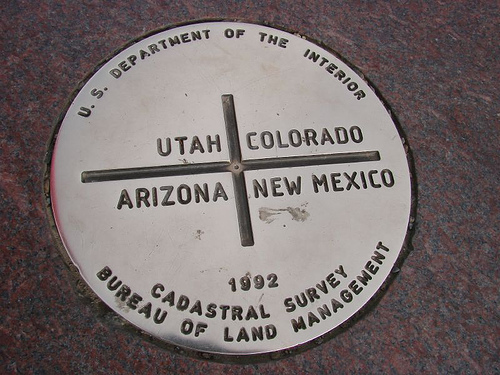
Interpretive signs - There is a bronze plaque in front of the steps along the New Mexico part of the granite slab. It reads: "In 1899, U.S. Surveyors Hubert Page and James Lentz found the four corners monument disturbed and broken. They marked and set a new stone at the original location. Everett Kimmell, General Land Office, re-monumented the Page-Lentz stone with a concrete and brass monument in 1931. The Bureau of Land Management and the Bureau of Indian Affairs poured a concrete paving block around the Kimmell monument in 1962. In 1992, Cadastral Surveyors Darryl Wilson and Jack Eaves officially re-monumented the deteriorating Kimmell marker with an aluminum bronze disc. The structure that you see today was rebuilt by the Bureau of Land Management." "The four corners area is surrounded by Indian lands. The Navajo Nation lies in New Mexico, Arizona and Utah. The Ute Mountain Ute Nation is in Colorado. Respect the culture and traditions of the four corners area." There is also a painted and peeling plywood map in front of the visitor's center with a schematic of the Monument (mostly the parking lot), as well as a map of the four states emblazoned with their respective state seals.
Visitor center - This is a double wide pre-fab trailer with some brochures and the occasional summertime demonstration of Native American crafts. August 2016 - The improved public restrooms are nearly complete. Very modern and convenient within the parking lot. It is a much needed addition to this site.
體驗活動
Visitors can get on their hands and knees so that their bodies are in all four states at the same time. There is a small elevated platform where someone else takes a picture of you as you touch four states. The platform is on the New Mexico and Arizona border. On busy days, be prepared to wait in line for your turn at the plaque. "Be courteous to other visitors and only take 3 pictures per group" - reads one sign. Dancing Horse Trail, a hiking trail that starts near the monument
購物
A majority of the 50 or so plywood stalls lie vacant, except in the high summer season. Mostly, there are many stalls hawking the obligatory tourist souvenirs, t-shirts and post cards. But amidst all the dreck, a handful of vendors sell authentic Native American arts and crafts. Real Navajo designs incorporate a flaw for the Yei bichai, a holy people in Navajo lore, leaving a portion of the design unfinished so the Yei spirit can escape. Beware of non-authentic imports from Mexico and overseas carried by unscrupulous "dealers" that have tried to capitalize on the market for Navajo work. A few items for sale include:
Dreamcatchers - Hoops with woven screens adorned with feathers and beads. Although they originated with the Ojibwa Nation in Canada in the 1970s, dreamcatchers are now widely made and sold by a variety of Native American peoples. Kachina Dolls - Not a traditional Navajo craft. Most likely these painted wood carvings are the works of other Pueblo Peoples, such as the Hopi in New Mexico, or are cheap knockoffs from China. Navajo rugs - Also known as a Navajo Blanket. Brightly colored weavings with intricate patterns are standard features of t
城市概覽改寫自 Wikipedia,旅遊指南來自Wikivoyage (CC BY-SA)。照片來自 Wikimedia Commons.