
East Village
United States · Americas
關於East Village
The East Village, east of the Village on Manhattan, was traditionally considered part of the Lower East Side, and constitutes the portion north of Houston St., south of 14th St., and east of Broadway. Although increasingly gentrified, with former crack dens that are now modern apartments so hip you can't afford them, it remains an ethnically diverse area of students, young professionals, immigrants, and older longtime residents. This colorful neighborhood is full of eateries as diverse as its population, and there's always something happening on St. Marks Place, 24/7.
East of 1st Av., encompassing the area from Av. A to the East River, is a sub-neighborhood often called Alphabet City or Loisaida (Spanglish for "Lower East Side"); Av. C's alternate name is "Loisaida Avenue." Parts of Alphabet City still have a Hispano-Caribbean feel, especially on Avs. D and C, but since most of Alphabet City is similar to the rest of the East Village now (diverse, gentrified, stylish), the separate designations are less used than was the case 2-3 decades ago. The area between Broadway and 3rd Av./Bowery, on the other hand, is sometimes called NoHo, for "North of Houston St." by analogy to SoHo to its south.
East Village旅遊指南
城市概覽
Early days The neighborhood now called the East Village was part of the hunting and gathering lands of local Native American tribes for thousands of years before the white man arrived. What's probably the oldest street in the neighborhood is now called Stuyvesant Street (with a listing in "See" below). Before it was a path during the time when Peter Stuyvesant, the only governor of New Netherland, owned a farm there (starting in 1651), it was a Native American trail. Stuyvesant continued to live in the area after New Netherland was ceded to the British, and his body was buried at St. Mark's Church in-the-Bowery (q.v.). In the 18th and early 19th centuries, some lovely multi-story buildings were built for wealthy pillars of New York society in the neighborhood. Many such buildings still stand, including the 1804 Hamilton Fish House at 21 Stuyvesant St.
Waves of immigration
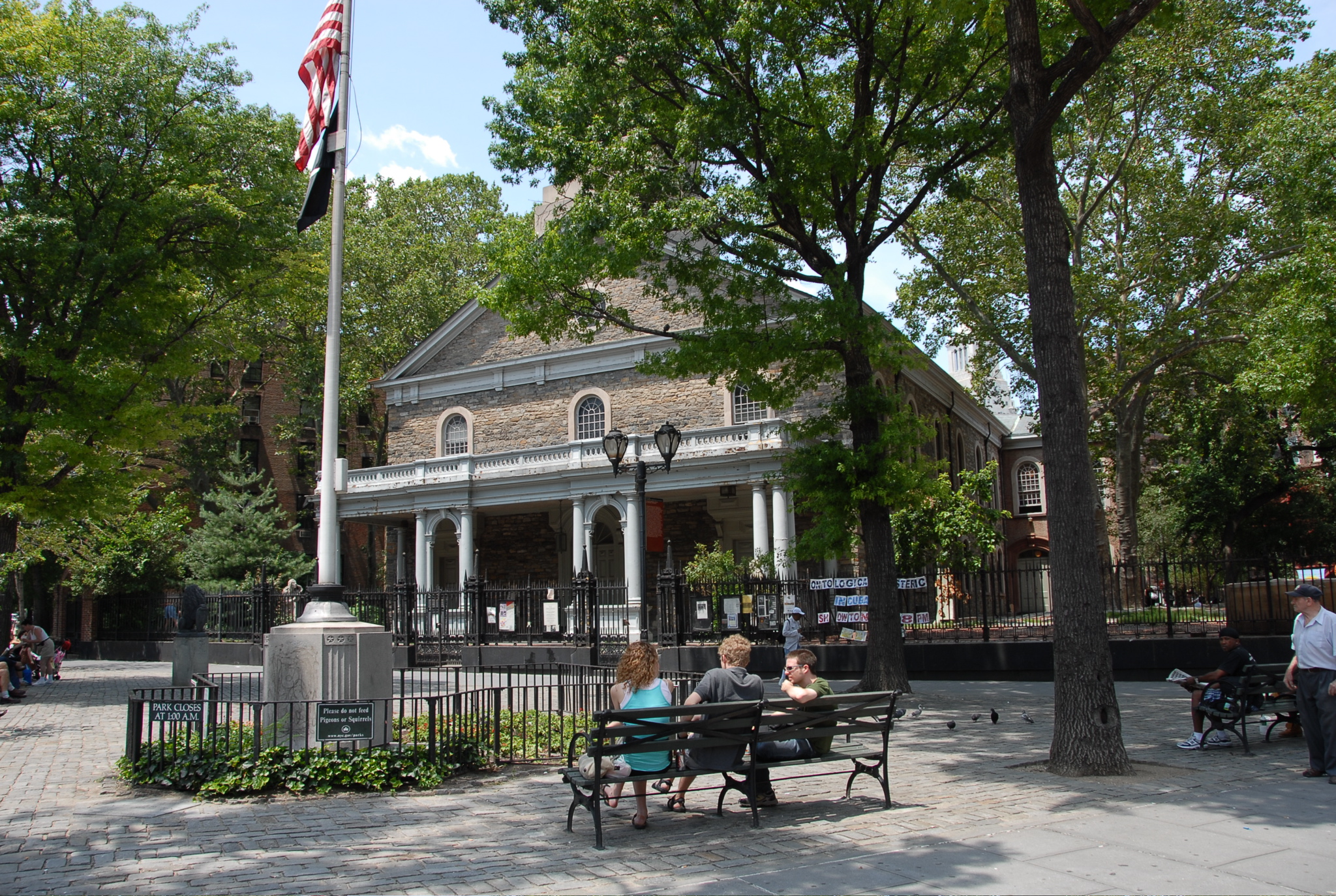
Following the failure of the 1848 democratic revolution in Germany, thousands of Germans immigrated to New York City and set up shop in what's now the East Village, the Lower East Side and Chinatown, and the entire area was known as Kleindeutschland ("Little Germany") until the early 20th century, when disaster struck. In the incident that caused the worst lost of life in New York of any single disaster prior to 2001, a ship called the General Slocum, which was ferrying Lutheran parishioners including most of the leading local German-American citizens to Long Island for a picnic in 1904, caught fire in the East River, killing over 1,000 people and essentially decapitating the community, many of whose remnants went uptown to Yorkville. If you look carefully, especially on St Marks Place, you can see relics of those days, including the Deutsch-Amerikanische Schützengesellschaft (German-American Shooting Club) near 3rd Av. and the German (now Korean) Evangelical Lutheran Church just east of 2nd Av., as well as the Ottendorfer Library on 2nd Av. between St Marks Place and 9th St. — and the Sixth
如何抵達
By subway
The best subway line for getting into the heart of the East Village is the 6 train, which stops at Astor Place, just one short block from St. Marks Place. You can also get out at Bleecker Street for more southerly East Village locations between Houston and 4th Streets. The R and W trains run under Broadway along the western edge of the neighborhood, stopping at 8th Street/NYU station near Astor Place. The L train is a rare crosstown train that runs along 14th Street, the northern edge of the East Village. The 3rd Avenue and especially the 1st Avenue stations can save you some steps if you're headed for more northerly or easterly destinations. The L can also take you to Greenwich Village or Brooklyn's Williamsburg, for a tour of bohemias of the comparatively recent and more distant past. There are also trains that run along the southern edge of the neighborhood, under Houston Street - take the B, D, F, or M to the Broadway-Lafayette station. The F also runs to the 2nd Avenue station. There are many trains that stop at Union Square, which is just past the northwest corner of the East Village - but it's something of a hike to the center of the neighborhood. Take the 4, 5, 6, N, Q, R, W or the L.
By bus Numerous MTA bus routes serve the neighborhood. Of particular note, however, are the crosstown buses. The M8 travels east on 8th St., then turns north on Av. A and travels on 10th St. the rest of the way. The M8 travels west on 10th St. and then starting on Av. A, on 9th St. The M14 14th St. crosstown is also notable because after going crosstown on 14th St. from the west side, the M14A bus turns down Av. A, whereas the M14D turns down Av. C and travels down Av. D starting at 10th St. You can also try your luck with the M21 Houston St. crosstown, though it doesn't run very frequently most of the time and like most other crosstown buses in Manhattan, it can also get caught in slow traffic. The 14th St. crosstown also used to get backed up on 14th St., but
必看景點
1 Alamo. A sculpture at the center of Astor Place. This steel cube actually rotates as you push on any side, though you may need the strength of two or three people for a complete rotation. One of its sister cubes resides on the University of Michigan campus in Ann Arbor, Michigan. This sculpture was removed in 2015 but returned to an enlarged pedestrian area in the fall of 2016. 2 Cooper Union, Cooper Square (Astor Place and 7th Street). Until 2014, Cooper Union was the only private, full-scholarship college in the United States dedicated exclusively to preparing students for the professions of art, architecture and engineering. It now charges tuition for regular classes but still gives free extension courses. The college, established in 1859, occupies several buildings, but the most recognizable and famous is the Foundation Building, on the block to the south of Astor Place between the two branches of Cooper Square (one being the southward extension of 3rd Av. and the other, an avenue that connects the Bowery with 4th Av. at Astor Place). The college, the legacy of Peter Cooper, occupies a special place in the history of American education. 3 East River Park, Montgomery St. to E. 12 St., FDR Drive. Most of this park is on the Lower East Side (and indeed the part of the East Village this far east is often also still called the Lower East Side or Loisaida), but the portion of it in the extreme East Village contains one or two baseball diamonds, some basketball courts, a playground or two and a well-tended path along the river that provides very worthwhile views in good weather. Popular with joggers, cyclists, picnickers, ball players, kids, and people taking a stroll. 4 Grace Church, 802 Broadway (at 10th St.), ☏ +1 212-254-2000. A lovely neo-Gothic Episcopal church, seemingly inspired by the Sainte-Chapelle in Paris. Free guided tours every Sunday at 1PM, or just walk past and look. Of course, there are also masses, and a concert series is given, too. 5 Museum
體驗活動
1 Anthology Film Archives, 32 Second Ave (Subway: F to 2nd Avenue). A varied program of unique films, both repertory and new, most playing for only one or two screenings. Many of the films shown here can't be seen anywhere else (for better or worse). It also plays host to several film festivals yearly. The 2 Public Theater and the adjoining Joe's Pub at 425 Lafayette St, are part of the lifeblood of the East Village. You can see shows, events, art, and Shakespeare, and hear some excellent performers of jazz, world music and so on at Joe's Pub. 3 Blue Man Group, Astor Place Theatre, 434 Lafayette St, ☏ +1 212-254-4370. 4 Russian & Turkish Baths, 268 E 10th St. Enjoy a day of self-indulgence with a very authentic Russian feel. Then nosh on bagels and cream cheese, or an authentic Russian meal in the restaurant. Maybe after all that shvitzing (that's Yiddish/New Yorkese for "sweating"): a huge bottle of seltzer, or fresh carrot juice is the thing you'll want most.
購物
Many souvenirs, articl
城市概覽改寫自 Wikipedia,旅遊指南來自Wikivoyage (CC BY-SA)。照片來自 Wikimedia Commons.