
Chiriquí Province
Panama · Americas
關於Chiriquí Province
The Pacific West of Panama includes all of Chiriqui Province, Herrera Province and Los Santos Province, and the southern portion of Veraguas Province.
Chiriquí Province旅遊指南
城市概覽
Chiriquí Province lies in the southwestern part of Panamá with its capital in David. Chiricanos are like the Texans of Panamá, and are loud, outgoing, and very proud of their province. However, they really seem to have something to be proud of. Chiriquí arguably has the friendliest people and the best landscape in Panamá. Offering the most varied scenery in this already diverse country, Chiriquí has an array of plant and animal species inhabiting the different ecosystems. Chiriquí’s topography ranges from the tallest mountain in the country, Volcan Baru in the highlands, to the more than 30 small islands in the archipelagos of the Gulf of Chiriquí near the coastal town of Boca Chica, known for its world-class sport fishing.
Climate Less than 9 degrees north of the equator, Panamá's temperatures are fairly consistent year round, with daytime temperatures in the 90s (°F) and nighttimes around 70 °F (21 °C), although the Chiriquí highlands get considerably cooler in the mountains. Like most of Panamá, Chiriquí’s lowlands have a rainy season from May through November and a dry season from December through April. During most of the rainy season, mornings and early afternoons are usually sunny while late afternoons and evenings have intermittent rainfall. Unlike most of the Caribbean, Mexico, and other Central American countries, Panamá does not experience hurricanes. The most popular time to travel to Panamá is December through March, when lack of humidity and nearly zero percent chance of rain make it ideal for travelers.
Talk Nearly a third of Panamá residents speak English, partially due to the many North American expatriates living there and the growing tourism sector, but an attempt at communication in the country's native Spanish is always appreciated.
如何抵達
By plane Fairly easy to get to from Panamá City. The fastest way is a 50 minute flight through Aeroperlas or Air Panamá who offer daily flights to David (DAV IATA) from Panamá’s Albrook Regional Airport. If traveling to Panamá from Costa Rica, there are direct flights from San José (SJO IATA) to David or Panamá City. Air Panamá serves the Chiriquí area with flights every Monday, Wednesday, and Friday. Construction is in progress to expand David's airport into a larger international facility with direct regular flights from the U.S. and Canada. The international airport, which receives up to 1800 passengers per week, has regular flights to Costa Rica and charter flights from the U.S. Expansion will soon allow for increased international traffic and larger aircraft.
By bus Also at the airport is the Albrook Bus Terminal where you can catch a bus to David leaving every 30 minutes.
By car You could opt for day long car ride from Panamá City via the Interamerican Highway touring small cities and villages along the way.
當地交通
Although David is not particularly interesting, it is a convenient transport hub for destinations in this region and you might want to go forth and back between this city by bus. There is also a pretty cheap luggage storage at the David bus terminal. Several well known rental car agencies are present within David, making it easy to find transportation for a trip. Rental cars may not be taken across the Costa Rican border. For travel within David, there are also plenty of taxis for easy transportation throughout the sprawling city. Because of the area’s growing tourism, Chiriquí's physical, economic, and social infrastructures have vastly improved. Roads are being improved, new high quality health care facilities being built, and major retailers are coming to the area. Much of this activity is centered in David; improvements include David's airport, Enrique Malek International Airport, whose incipient acceptance of direct international flights should mark the tipping point for the area in terms of tourism and development. Volcan to Cerro Punto: $1.35
必看景點
The Chiriquí Lowlands The Gulf of Chiriquí, much of Panamá’s best, numerous archipelagos star the gulf with islands and reefs, including Central America’s largest island, Coiba Island, right inside Coiba National Marine Park. And right next to it the Parque Nacional Marino Golfo de Chiriquí. The whole area is home to the richest mangroves and rarest pelagic marine species in the world. It has a reputation as a world-class sport fishing destination, as evidenced by Saltwater Fisherman Magazine, which named it the best place in the world for catching the Black Marlin in their April 2009 issue. The Gulf of Chiriquí is so large and species-rich some consider it a small sea. Well known among insiders for its boating, sport fishing, surfing, scuba diving and snorkelling opportunities, the unspoiled and largely undiscovered coastal and marine environments in the area rival the best on the Pacific coasts of Central America and Mexico.
The Chiriquí Highlands There is plenty of beautiful places to be had in the rolling mountains of Chiriquí’s highlands. Boquete, a hot spot for nature-lovers ecotourism destination. Volcan Barú, the jagged, lush green mountains of Chiriquí rise to the top of Volcan Barú, Panamá's largest volcano. With over 900 species of birds in Panamá it is no surprise that avid bird watchers too visit yearly to spot the ever elusive Resplendent Quetzal and other of Panamá’s beautiful avian species. The mountain is also the only place in the world to catch a glimpse of both the Atlantic and Pacific Ocean at the same time, although clear days can be difficult to come by. La Amistad International Park, near Cerro Punta, about 72 km outside of David and 13 km north of Volcan Barú, this park is actually shared and jointly managed with neighboring Costa Rica. While the majority of the Panamanian side of the park is in Bocas Del Toro, the small percentage that is in the Chiriquí Province is more easily accessible. La Amistad is home to the majority of endanger
體驗活動
In the following some specific destinations that can be reached conveniently from Boquete, David, or Boca Chica.
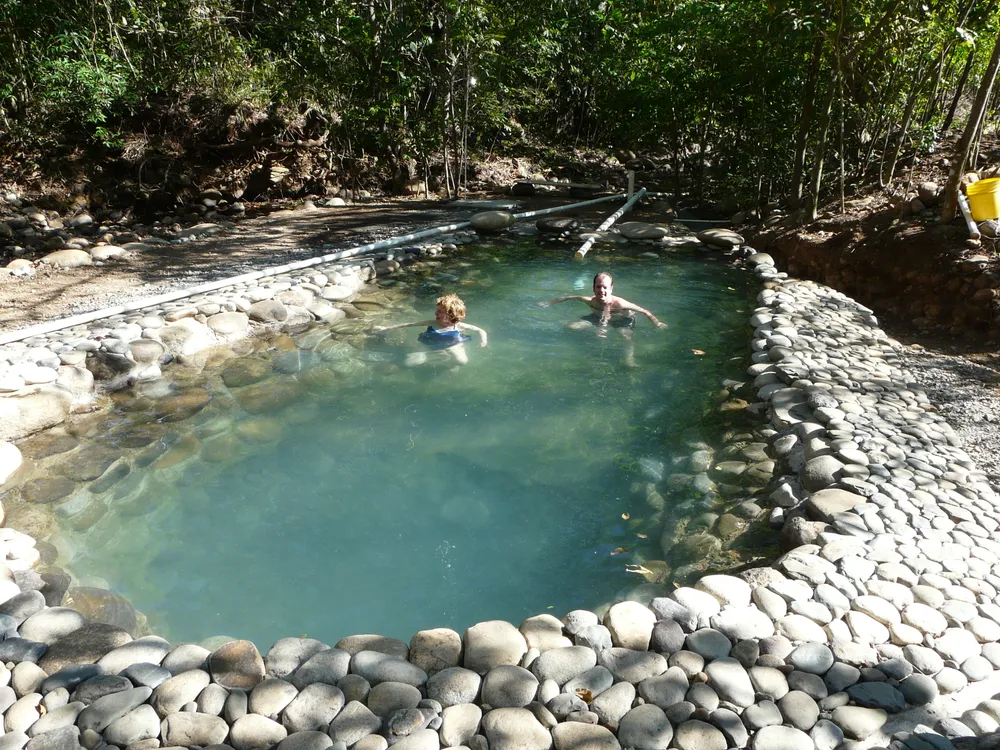
Hot Springs Caldera can be visited by bus from Boquete or a roundtrip taxi. Although the volcano has been dormant for over 600 years, there are thermal springs bubbling up around it. These hot and bubbly mineral water are right next to the Caldera River. Take a dip in both hot and cold. There are also the Petroglifos de Caldera nearby in Caldera, which you might want to check out. The region has several other areas with active springs. In Volcan, on the northern side of the Volcan Baru, about 30 min from town, there are several springs. However, due to the mineral content, there is a slight sulphur smell.
Cangilones de Gualaca is an interesting geological formation and stream great for swimming, jumping from a 5-m cliff or just chilling in the shades. Bring your goggles, sunscreen, water and food. Macho de Monte Canyon south of Volcan is an impressive canyon good for swimming and chilling with a beer.
General Boquete is well known for adventure travel, which includes white-
城市概覽改寫自 Wikipedia,旅遊指南來自Wikivoyage (CC BY-SA)。照片來自 Wikimedia Commons.